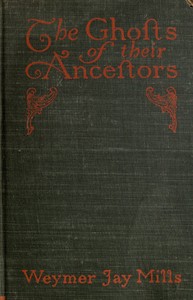
length
12,955 words
a few pages a day
~8 min
finished in
7 days
full read
54 min
At Folio's default of ten pages a day, you finish The ghosts of their ancestors in about 7 days — roughly 8 minutes of reading each morning.
The opening
the first pages of The ghosts of their ancestors, free
There was a clanging, brassy melody upon the air. For three-score years since York of the Scarlet Coats died, and the tune "God Save the King" floated for the last time out of tavern door and mansion window, the bells of old St. Paul's had begun their ringing like this:
"Loud and full voiced at eight o'clock sends good cheer abroad," said the tottering sexton. "Softer and softer, as folks turn into bed, and faint and sweet at midnight, when our dear Lord rises with the dawn." Cheery bells full of hope--gentle chimes, as if the holy mother were dreaming of her babe. Joyous, jingling, jangling bells! Through the town their tones drifted, over the thousands of slate-colored roofs, now insistent on the Broadway, now lessening a little in some long winding alley, and then finally dying away on the bare Lispenard Meadows.
Vesey Street--the gentry street--heard them first. The bigwigs in the long ago, with the help of Gracious George, built the church, and who had a better right than their children to its voices. Calm and serene lay Vesey Street with its rows of leafing elms. Over the dim confusion of architectural forms slipped the moonlight in silver ribbons, seeming to make sport of the grave, smug faces of the antiquated domiciles. Like a line of deserted dowagers waiting for some recalcitrant Sir Roger de Coverley, they stood scowling at one another. No longer linkboys and running footmen stuck brave lights into the well-painted extinguishers at each doorstep. No longer fashion fluttered to their gates. The gallants who had been wont to pass them with, "Lud! what a pretty house!" were most of them asleep now on the green breast of mother England, forgetful of that wide thoroughfare, which had never reckoned life without them.
Into the parlor of Knickerbocker House, dubbed Knickerbocker Mansion some years after the bibulous Sir William Howe had laid down his sceptre as ruler of the town, the chorus of bells crashed.
"What a dastardly noise!" cried Jonathan Knickerbocker, throwing his newspaper over his head. "Can this Easter time never be kept without an infernal bell bombilation? I shall call a meeting of the vestry--that idiot Jenkins should be kept at home!"
The head of the Knickerbocker family turned irately in his chair and glared at his daughters. Three timid pairs of blinking eyes were raised from short sacks in answer to his challenge, then lowered again over the wool. The fourth and fairest daughter of the house, seated on the walnut sofa in the bow-window, gave no heed to his vehemence but a suppressed sigh. With a final snort the Gazette was picked up again. The Easter melody was waning.
[Illustration]
[Illustration]
The Knickerbocker parlor--not the state parlor, which had long been closed--was a dismal place--so large that four candles and one Rumford lamp made but a patch of brightness in the gloom. Most of the furniture was ponderous and ugly, with two or three alien little chairs that looked as if they might once have belonged to some light-hearted lover of the Louis. On the almost barren chimney-piece stood a pair of tall nankeen beakers, sepulchrally reminiscent of buried Chinese years. Along the walls hung a score of mediocre portraits, the handiwork of the usurious limner John Watson and his compatriot Hessilius. Spans of sunlit days had stolen every tinge of carmine from their immobile and woodeny faces, leaving them the drab color of time, in keeping with the room.
Above the cornice, near the sofa where Patricia Knickerbocker sat, hung an empty frame. The portrait it contained had been banished to the attic while her three eldest sisters were still in Wellington pantalets.
"The woman looks like a Jezebel," Jonathan had sputtered. "Och! that leering smile." He tried to blot from his mind the stray leaves he knew of her story, and the disturbing thought that she was of his blood. "She shall not remain with the likenesses of my ancestors!" he had told his sisters, who were over from Goby House.
When this descendant of the Knickerbockers spoke of his progenitors he always held his head a trifle more erect, and puffed out his pompous figure, though, strange to relate, like many another worthy man of a later day having the same foible, he knew very little about them. Of course he could have told you that the lady over the east bookcase, wearing a blue tucker and holding a spray of milk-weed in her hand, was his Aunt Jane; and that his father was a noted New York judge, the pride of three circuits. Or if his digression were extended, there was his trump card, one of the first American Knickerbockers, labelled "The Friend of Lord Cornbury!" These were the firmest rocks in his family history, to which he could climb in safety, thence to look down with scorn on those unfortunates beneath his social eminence. He was a Knickerbocker, of Knickerbocker Mansion, Vesey Street, and a member of one of the oldest families in York and America.
Keep going from exactly here — Folio remembers your place and serves the next portion tomorrow.
continue reading The ghosts of their ancestorsAbout this free edition
The ghosts of their ancestors by Weymer Jay Mills (1880-1938) is free to read in full. Folio serves it in daily portions you can actually finish, tracks your streak and reading position across devices, and reads every page aloud with a built-in narrator. The text comes from Project Gutenberg.
More like The ghosts of their ancestors
Through the Gates of Old Romance
Weymer Jay Mills
Dracula
Bram Stoker
The Strange Case of Dr. Jekyll and Mr. Hyde
Robert Louis Stevenson
The Turn of the Screw
Folio
The Turn of the Screw
Henry James

The Picture of Dorian Gray
Oscar Wilde
The Fall of the House of Usher
Folio
The Fall of the House of Usher
Edgar Allan Poe
Carmilla
Joseph Sheridan Le Fanu
Uncle Silas
Folio
Uncle Silas
Joseph Sheridan Le Fanu