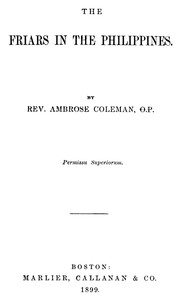
The Friars in the Philippines
free to read
length
34,415 words
a few pages a day
~8 min
finished in
19 days
full read
2h 23m
At Folio's default of ten pages a day, you finish The Friars in the Philippines in about 19 days — roughly 8 minutes of reading each morning.
The opening
the first pages of The Friars in the Philippines, free
A recent traveller designates the Philippines as the birthplace of typhoons, the home of earthquakes,--epithets undoubtedly strong yet well deserved; and typhoons at certain seasons of the year, with earthquakes at uncertain periods, when taken together with the torrid heat, trying at all seasons, and the malaria fruitful of fevers, make these islands of the Eastern seas, which otherwise would be a veritable Paradise upon earth, an undesirable place of abode to the average European, unless, indeed, he is attracted thither by the greed of gain or by the nobler desire of missionary enterprise.
For Nature, bountiful there almost to prodigality, revelling in all the luxuriance of tropical vegetation, has always at hand, as a set-off to her gifts, terrible manifestations of her power. The seventeenth-century navigator, William Dampier, in his own quaint and amusing way, describes how the natives and the Spanish colonists of Manila strove to guard against the double danger of earthquakes and typhoons, and how they both failed ignominiously. The Spaniards built strong stone houses, but the earthquake made light of them, and shook them so violently that the terrified inmates would rush out of doors to save their lives; while the natives from their frail bamboo dwellings, which were perched on high poles, placidly contemplated their discomfiture. All that the earthquake meant to them was a gentle swaying from side to side. But the Spaniards had their turn when the fierce typhoon blew, against which their thick walls were proof. Then, from the security of their houses, could they view, with a certain grim satisfaction, the huts of the natives swaying every minute more violently in the wind, till, one by one, they toppled over--each an indescribable heap of poles, mats, household utensils, and human beings.
By way of general description it may be said that the Philippine Archipelago consists of between one and two thousand islands; two of which, Luzon and Mindanao, are much larger than Ireland, while the rest vary in size down to mere islets, rocks, and reefs. Altogether the islands stretch from north to south a distance as great as from the north of England to the south of Italy. The soil is extremely rich, and easily cultivated; vast forests abound, containing valuable timber; and the mineral resources, up to the present undeveloped, are apt to prove a sure source of income under modern methods of working.
But what concerns us most in this inquiry is the character of the inhabitants. The population, which is variously estimated at from eight to ten millions, is made up of more than eighty distinct tribes, which nearly all belong to the Malay race. There are still to be found in some of the islands, and principally in the mountainous districts, the remnants of the aboriginal inhabitants, usually called Negritos. These are of a distinctively inferior type, are rapidly diminishing in numbers, and seem to many observers incapable of civilization. Our only concern therefore is with the Malays, who form the vast bulk of the population, and have in the course of time been nearly all converted to Christianity. Nearly seven million Christians are counted among them; while the unconverted pagans, together with the Moros, or Malay Mohammedans, of Mindanao and the Sulu islands, are not a million in number.
Keep going from exactly here — Folio remembers your place and serves the next portion tomorrow.
continue reading The Friars in the PhilippinesAbout this free edition
The Friars in the Philippines by Ambrose Coleman (1858-) is free to read in full. Folio serves it in daily portions you can actually finish, tracks your streak and reading position across devices, and reads every page aloud with a built-in narrator. The text comes from Project Gutenberg.
More like The Friars in the Philippines
The History of the Peloponnesian War
Folio
The History of the Peloponnesian War
Thucydides
The History of Herodotus
Folio
The History of Herodotus
Herodotus
The Gallic Wars
Folio
The Gallic Wars
Julius Caesar
Anabasis
Folio
Anabasis
Xenophon
The Lives of the Twelve Caesars
Folio
The Lives of the Twelve Caesars
Suetonius
Germania
Folio
Germania
Tacitus

The History of the Decline and Fall of the Roman Empire
Edward Gibbon
The Travels of Marco Polo
Marco Polo