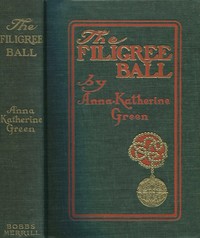
length
89,785 words
a few pages a day
~8 min
finished in
48 days
full read
6h 14m
At Folio's default of ten pages a day, you finish The Filigree Ball in about 48 days — roughly 8 minutes of reading each morning.
The opening
the first pages of The Filigree Ball, free
For a detective whose talents, had not been recognized at headquarters, I possessed an ambition which, fortunately for my standing with the lieutenant of the precinct, had not yet been expressed in words. Though I had small reason for expecting great things of myself, I had always cherished the hope that if a big case came my way I should be found able to do something with it something more, that is, than I had seen accomplished by the police of the District of Columbia since I had had the honor of being one of their number. Therefore, when I found myself plunged, almost without my own volition, into the Jeffrey-Moore affair, I believed that the opportunity had come whereby I might distinguish myself.
It had complications, this Jeffrey-Moore affair; greater ones than the public ever knew, keen as the interest in it ran both in and out of Washington. This is why I propose to tell the story of this great tragedy from my own standpoint, even if in so doing I risk the charge of attempting to exploit my own connection with this celebrated case. In its course I encountered as many disappointments as triumphs, and brought out of the affair a heart as sore as it was satisfied; for I am a lover of women and—
But I am keeping you from the story itself.
I was at the station-house the night Uncle David came in. He was always called Uncle David, even by the urchins who followed him in the street; so I am showing him no disrespect, gentleman though he is, by giving him a title which as completely characterized him in those days, as did his moody ways, his quaint attire and the persistence with which he kept at his side his great mastiff, Rudge. I had long since heard of the old gentleman as one of the most interesting residents of the precinct. I had even seen him more than once on the avenue, but I had never before been brought face to face with him, and consequently had much too superficial a knowledge of his countenance to determine offhand whether the uneasy light in his small gray eyes was natural to them, or simply the result of present excitement. But when he began to talk I detected an unmistakable tremor in his tones, and decided that he was in a state of suppressed agitation; though he appeared to have nothing more alarming to impart than the fact that he had seen a light burning in some house presumably empty.
It was all so trivial that I gave him but scant attention till he let a name fall which caused me to prick up my ears and even to put in a word. “The Moore house,” he had said.
“The Moore house?” I repeated in amazement. “Are you speaking of the Moore house?”
A thousand recollections came with the name.
“What other?” he grumbled, directing toward me a look as keen as it was impatient. “Do you think that I would bother myself long about a house I had no interest in, or drag Rudge from his warm rug to save some ungrateful neighbor from a possible burglary? No, it is my house which some rogue has chosen to enter. That is,” he suavely corrected, as he saw surprise in every eye, “the house which the law will give me, if anything ever happens to that chit of a girl whom my brother left behind him.”
Growling some words at the dog, who showed a decided inclination to lie down where he was, the old man made for the door and in another moment would have been in the street, if I had not stepped after him.
“You are a Moore and live in or near that old house?” I asked.
The surprise with which he met this question daunted me a little.
Keep going from exactly here — Folio remembers your place and serves the next portion tomorrow.
continue reading The Filigree BallAbout this free edition
The Filigree Ball by Anna Katharine Green (1846-1935) is free to read in full. Folio serves it in daily portions you can actually finish, tracks your streak and reading position across devices, and reads every page aloud with a built-in narrator. The text comes from Project Gutenberg.
More like The Filigree Ball
The Leavenworth Case
Anna Katharine Green
Hand and Ring
Anna Katharine Green
That Affair Next Door
Folio
That Affair Next Door
Anna Katharine Green

The Circular Study
Anna Katharine Green
The Golden Slipper, and Other Problems for Violet Strange
Folio
The Golden Slipper, and Other Problems for Violet Strange
Anna Katharine Green

The Mystery of the Hasty Arrow
Anna Katharine Green
The Mill Mystery
Folio
The Mill Mystery
Anna Katharine Green

Dark Hollow
Anna Katharine Green