length
77,442 words
a few pages a day
~8 min
finished in
41 days
full read
5h 23m
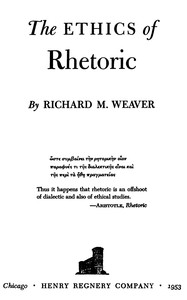
At Folio's default of ten pages a day, you finish The ethics of rhetoric in about 41 days — roughly 8 minutes of reading each morning.
The opening
the first pages of The ethics of rhetoric, free
Our subject begins with the threshold difficulty of defining the question which Plato’s Phaedrus was meant to answer. Students of this justly celebrated dialogue have felt uncertain of its unity of theme, and the tendency has been to designate it broadly as a discussion of the ethical and the beautiful. The explicit topics of the dialogue are, in order: love, the soul, speechmaking, and the spoken and written word, or what is generally termed by us “composition.” The development looks random, and some of the most interesting passages appear jeux d’esprit. The richness of the literary art diverts attention from the substance of the argument.
But a work of art which touches on many profound problems justifies more than one kind of reading. Our difficulty with the Phaedrus may be that our interpretation has been too literal and too topical. If we will bring to the reading of it even a portion of that imagination which Plato habitually exercised, we should perceive surely enough that it is consistently, and from beginning to end, about one thing, which is the nature of rhetoric.[1] Again, that point may have been missed because most readers conceive rhetoric to be a system of artifice rather than an idea,[2] and the Phaedrus, for all its apparent divagation, keeps very close to a single idea. A study of its rhetorical structure, especially, may give us the insight which has been withheld, while making us feel anew that Plato possessed the deepest divining rod among the ancients.
For the imaginative interpretation which we shall now undertake, we have both general and specific warrant. First, it scarcely needs pointing out that a Socratic dialogue is in itself an example of transcendence. Beginning with something simple and topical, it passes to more general levels of application; and not infrequently, it must make the leap into allegory for the final utterance. This means, of course, that a Socratic dialogue may be about its subject implicitly as well as explicitly. The implicit rendering is usually through some kind of figuration because it is the nature of this meaning to be ineffable in any other way. It is necessary, therefore, to be alert for what takes place through the analogical mode.
Second, it is a matter of curious interest that a warning against literal reading occurs at an early stage of the Phaedrus. Here in the opening pages, appearing as if to set the key of the theme, comes an allusion to the myth of Boreas and Oreithyia. On the very spot where the dialogue begins, Boreas is said to have carried off the maiden. Does Socrates believe that this tale is really true? Or is he in favor of a scientific explanation of what the myth alleges? Athens had scientific experts, and the scientific explanation was that the north wind had pushed her off some rocks where she was playing with a companion. In this way the poetical story is provided with a factual basis. The answer of Socrates is that many tales are open to this kind of rationalization, but that the result is tedious and actually irrelevant. It is irrelevant because our chief concern is with the nature of the man, and it is beside the point to probe into such matters while we are yet ignorant of ourselves. The scientific criticism of Greek mythology, which may be likened to the scientific criticism of the myths of the Bible in our own day, produces at best “a boorish sort of wisdom (ἀγροίκῳ τινὶ σοφίᾳ).” It is a limitation to suppose that the truth of the story lies in its historicity. The “boorish sort of wisdom” seeks to supplant poetic allegation with fact, just as an archaeologist might look for the foundations of the Garden of Eden. But while this sort of search goes on the truth flies off, on wings of imagination, and is not recoverable until the searcher attains a higher level of pursuit. Socrates is satisfied with the parable, and we infer from numerous other passages that he believed that some things are best told by parable and some perhaps discoverable only by parable. Real investigation goes forward with the help of analogy. “Freud without Sophocles is unthinkable,” a modern writer has said.[3]
Keep going from exactly here — Folio remembers your place and serves the next portion tomorrow.
continue reading The ethics of rhetoricAbout this free edition
The ethics of rhetoric by Richard M. Weaver (1910-1963) is free to read in full. Folio serves it in daily portions you can actually finish, tracks your streak and reading position across devices, and reads every page aloud with a built-in narrator. The text comes from Project Gutenberg.
More like The ethics of rhetoric
Meditations
Folio
Meditations
Marcus Aurelius
The Enchiridion
Epictetus

Thus Spake Zarathustra
Friedrich Nietzsche
Beyond Good and Evil
Folio
Beyond Good and Evil
Friedrich Nietzsche
The Genealogy of Morals
Folio
The Genealogy of Morals
Friedrich Nietzsche
The Republic
Folio
The Republic
Plato
Apology
Folio
Apology
Plato
Crito
Folio
Crito
Plato