length
231,685 words
a few pages a day
~8 min
finished in
122 days
full read
16h 5m
At Folio's default of ten pages a day, you finish The decline of the West in about 122 days — roughly 8 minutes of reading each morning.
The opening
the first pages of The decline of the West, free
This version of the text cannot represent certain typographical effects. Italics are delimited with the ‘’ character as italic_. A number of long horizontal and vertical brackets are simulated. Superscripted characters are preceded by ‘^’, and if multiple characters are raised, they are delimited by ‘{}’.
Footnotes have been moved to follow the sections in which they are referenced.
Minor errors, attributable to the printer, have been corrected. Please see the transcriber’s note at the end of this text for details regarding the handling of any textual issues encountered during its preparation.
------------------------------------------------------------------------
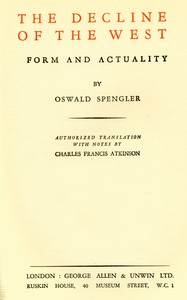
THE DECLINE OF THE WEST
[Illustration]
THE DECLINE OF THE WEST FORM AND ACTUALITY
BY
OSWALD SPENGLER
AUTHORIZED TRANSLATION WITH NOTES BY
CHARLES FRANCIS ATKINSON
LONDON: GEORGE ALLEN & UNWIN LTD. RUSKIN HOUSE, 40 MUSEUM STREET, W.C. 1
PRINTED IN THE UNITED STATES OF AMERICA
THIS TRANSLATION IS DEDICATED TO ELLINOR JAMES
A FRIEND
_Wenn im Unendlichen dasselbe Sich wiederholend ewig fliesst, Das tausendfältige Gewölbe Sich kräftig ineinander schliesst; Strömt Lebenslust aus allen Dingen, Dem kleinsten wie dem grössten Stern, Und alles Drängen, alles Ringen Ist ewige Ruh in Gott dem Herrn._ —GOETHE.
TRANSLATOR’S PREFACE
It must be left to critics to say whether it was Destiny or Incident— using these words in the author’s sense—that Spengler’s “Untergang des Abendlandes” appeared in July, 1918, that is, at the very turning-point of the four years’ World-War. It was conceived, the author tells us, before 1914 and fully worked out by 1917. So far as he is concerned, then, the impulse to create it arose from a view of our civilization not as the late war left it, but (as he says expressly) as the coming war would find it. But inevitably the public impulse to read it arose in and from post-war conditions, and thus it happened that this severe and difficult philosophy of history found a market that has justified the printing of 90,000 copies. Its very title was so apposite to the moment as to predispose the higher intellectuals to regard it as a work of the moment—the more so as the author was a simple Oberlehrer and unknown to the world of authoritative learning.
Spengler’s was not the only, nor indeed the most “popular,” philosophical product of the German revolution. In the graver conjunctures, sound minds do not dally with the graver questions—they either face and attack them with supernormal resolution or thrust them out of sight with an equally supernormal effort to enjoy or to endure the day as it comes. Even after the return to normality, it is no longer possible for men—at any rate for Western men—not to know that these questions exist. And, if it is none too easy even for the victors of the struggle to shake off its sequelæ, to turn back to business as the normal and to give no more than amateur effort and dilettantish attention to the very deep things, for the defeated side this is impossible. It goes through a period of material difficulty (often extreme difficulty) and one in which pride of achievement and humility in the presence of unsuccess work dynamically together. So it was with sound minds in the post-Jena Germany of Jahn and Fichte, and so it was also with such minds in the Germany of 1919-1920.
Keep going from exactly here — Folio remembers your place and serves the next portion tomorrow.
continue reading The decline of the WestAbout this free edition
The decline of the West by Oswald Spengler (1880-1936) is free to read in full. Folio serves it in daily portions you can actually finish, tracks your streak and reading position across devices, and reads every page aloud with a built-in narrator. The text comes from Project Gutenberg.
More like The decline of the West
Meditations
Folio
Meditations
Marcus Aurelius

The Enchiridion
Epictetus

Thus Spake Zarathustra
Friedrich Nietzsche
Beyond Good and Evil
Folio
Beyond Good and Evil
Friedrich Nietzsche
The Genealogy of Morals
Folio
The Genealogy of Morals
Friedrich Nietzsche
The Republic
Folio
The Republic
Plato
Apology
Folio
Apology
Plato
Crito
Folio
Crito
Plato