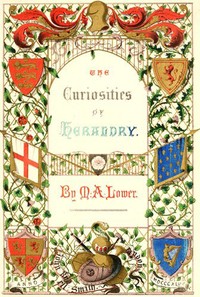
length
87,346 words
a few pages a day
~8 min
finished in
46 days
full read
6h 4m
At Folio's default of ten pages a day, you finish The Curiosities of Heraldry in about 46 days — roughly 8 minutes of reading each morning.
The opening
the first pages of The Curiosities of Heraldry, free
Little need be said to the lover of antiquity in commendation of the subject of this volume; and I take it for granted that every one who reads the history of the Middle Ages in a right spirit will readily acknowledge that Heraldry, as a system, is by no means so contemptible a thing as the mere utilitarian considers it to be. Yet, notwithstanding, how few are there who have even a partial acquaintance with its principles. To how many, even of those who find pleasure in archæological pursuits, does the charge apply:
"--neque enim clypei cælamina norit."
Two hundred years ago, when the study of armory was much more cultivated than at present, this general ignorance of our 'noble science' called forth the censure of its admirers. Master Ri. Brathwait, lamenting it, says of some of his contemporaries:
"They weare theire grandsire's signet on their thumb, Yet aske them whence their crest is, they are mum;"
and adds:
"Who weare gay coats, but can no coat deblaze, Display'd for gulls, may bear gules in their face!"[1]
This invective is perhaps a little too severe, yet it is mildness itself when compared with that of Ranulphus Holme, son of the author of the 'Academy of Armory,' who declares that unless the reader assents to what is contained in his father's book he is
"neither Art's nor Learning's friend, But an ignorant, empty, brainless sot, Whose chiefest study is the can and pot!"
Now, though I would by no means place the objector to Heraldry upon the same bench with the devotee of Bacchus, nor even upon the stool of the dunce, yet I hope to make it appear that the study is worthy of more attention than is generally conceded to it.[2] At the same time I wish it to be distinctly understood that I do not over-rate its importance. "The benefit arising from different pursuits will differ, of course, in degree, but nothing that exercises the intellect can be useless, and in this spirit it may be possible to study even conchology without degradation."
Many persons regard arms as nothing more than a set of uncouth and unintelligible emblems by which families are distinguished from one another; the language by which they are described as an antiquated "jargon;" and both as little worthy of an hour's examination as astrology, alchemy or palmistry. This is a mistake; and such individuals are guilty, however unintentionally, of a great injustice to a lordly, poetical, and useful science.
That Heraldry is a lordly science none will deny; that it is also a poetical science I shall shortly attempt to prove; but there are some sour spirits who know not how to dissever the idea of lordliness from that of tyranny, and who "thank the gods for not having made them poetical." These, therefore, will be no recommendations of our subject to such readers; but should I be able to show that it is a useful science, what objections can those cavillers then raise?
I purpose to give a short dissertation on the utility of Heraldry, but first let me say a few words on the poetry of the subject. Do not the 'Lion of England,' the 'Red-Cross Banner,' the 'White and Red Roses,' the 'Shamrock of Ireland,' and 'Scotia's barbed Thistle' occupy a place in the breast of every patriot? and what are they but highly poetical expressions? Do not the poetry of Chaucer and Spenser and Shakspeare, not to mention our old heroic ballads and the pleasant legends of a Scott, abound with heraldrical allusions? Tasso is minute, though inaccurate, in the description of the banners of his Christian heroes; he was far from despising blazon as a poetical accessory. And, lastly, see how nobly the stately Drayton makes the 'jargon' of Heraldry chime in with his glorious numbers:
Keep going from exactly here — Folio remembers your place and serves the next portion tomorrow.
continue reading The Curiosities of HeraldryAbout this free edition
The Curiosities of Heraldry by Mark Antony Lower (1813-1876) is free to read in full. Folio serves it in daily portions you can actually finish, tracks your streak and reading position across devices, and reads every page aloud with a built-in narrator. The text comes from Project Gutenberg.
More like The Curiosities of Heraldry
The History of the Peloponnesian War
Folio
The History of the Peloponnesian War
Thucydides
The History of Herodotus
Folio
The History of Herodotus
Herodotus
The Gallic Wars
Folio
The Gallic Wars
Julius Caesar
Anabasis
Folio
Anabasis
Xenophon
The Lives of the Twelve Caesars
Folio
The Lives of the Twelve Caesars
Suetonius
Germania
Folio
Germania
Tacitus
The History of the Decline and Fall of the Roman Empire
Edward Gibbon

The Travels of Marco Polo
Marco Polo