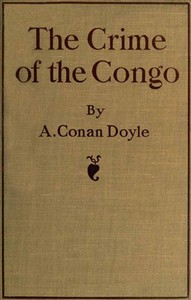
length
51,650 words
a few pages a day
~8 min
finished in
28 days
full read
3h 35m
At Folio's default of ten pages a day, you finish The Crime of the Congo in about 28 days — roughly 8 minutes of reading each morning.
The opening
the first pages of The Crime of the Congo, free
There are many of us in England who consider the crime which has been wrought in the Congo lands by King Leopold of Belgium and his followers to be the greatest which has ever been known in human annals. Personally I am strongly of that opinion. There have been great expropriations like that of the Normans in England or of the English in Ireland. There have been massacres of populations like that of the South Americans by the Spaniards or of subject nations by the Turks. But never before has there been such a mixture of wholesale expropriation and wholesale massacre all done under an odious guise of philanthropy and with the lowest commercial motives as a reason. It is this sordid cause and the unctious hypocrisy which makes this crime unparalleled in its horror.
The witnesses of the crime are of all nations, and there is no possibility of error concerning facts. There are British consuls like Casement, Thesiger, Mitchell and Armstrong, all writing in their official capacity with every detail of fact and date. There are Frenchmen like Pierre Mille and Félicien Challaye, both of whom have written books upon the subject. There are missionaries of many races--Harris, Weeks and Stannard (British); Morrison, Clarke and Shepherd (American); Sjoblom (Swedish) and Father Vermeersch, the Jesuit. There is the eloquent action of the Italian Government, who refused to allow Italian officers to be employed any longer in such hangman's work, and there is the report of the Belgian commission, the evidence before which was suppressed because it was too dreadful for publication; finally, there is the incorruptible evidence of the kodak. Any American citizen who will glance at Mark Twain's "King Leopold's Soliloquy" will see some samples of that. A perusal of all of these sources of information will show that there is not a grotesque, obscene or ferocious torture which human ingenuity could invent which has not been used against these harmless and helpless people.
This would, to my mind, warrant our intervention in any case. Turkey has several times been interfered with simply on the general ground of humanity. There is in this instance a very special reason why America and England should not stand by and see these people done to death. They are, in a sense, their wards. America was the first to give official recognition to King Leopold's enterprise in 1884, and so has the responsibility of having actually put him into that position which he has so dreadfully abused. She has been the indirect and innocent cause of the whole tragedy. Surely some reparation is due. On the other hand England has, with the other European Powers, signed the treaty of 1885, by which each and all of them make it responsible for the condition of the native races. The other Powers have so far shown no desire to live up to this pledge. But the conscience of England is uneasy and she is slowly rousing herself to act. Will America be behind?
At this moment two American citizens, Shepherd and that noble Virginian, Morrison, are about to be tried at Boma for telling the truth about the scoundrels. Morrison in the dock makes a finer Statue of Liberty than Bartholdi's in New York harbour.
Keep going from exactly here — Folio remembers your place and serves the next portion tomorrow.
continue reading The Crime of the CongoAbout this free edition
The Crime of the Congo by Arthur Conan Doyle (1859-1930) is free to read in full. Folio serves it in daily portions you can actually finish, tracks your streak and reading position across devices, and reads every page aloud with a built-in narrator. The text comes from Project Gutenberg.
More like The Crime of the Congo
The Adventures of Sherlock Holmes
Arthur Conan Doyle
The Hound of the Baskervilles
Arthur Conan Doyle
A Study in Scarlet
Folio
A Study in Scarlet
Arthur Conan Doyle
The Sign of the Four
Arthur Conan Doyle
The Memoirs of Sherlock Holmes
Arthur Conan Doyle
The Return of Sherlock Holmes
Arthur Conan Doyle
His Last Bow
Arthur Conan Doyle
The Valley of Fear
Arthur Conan Doyle