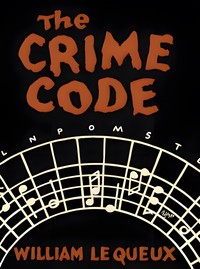
length
73,592 words
a few pages a day
~8 min
finished in
39 days
full read
5h 7m
At Folio's default of ten pages a day, you finish The crime code in about 39 days — roughly 8 minutes of reading each morning.
The opening
the first pages of The crime code, free
At the outset I wish to impress on those who read this straightforward and unembellished narrative of my amazing and often exciting adventures, that I seek not to hide my own shortcomings, for they are alas! many; nor do I in the least desire to pose as a vainglorious hero. At least, I am not one who slops about in the oozy slime of the sex problem.
From leading the normal life of an ordinary young man about London, I was, by a strange freak of ill-fortune, and in the space of a single minute, plunged into a veritable vortex of doubt and misery, compelled to lead the life of a hunted criminal, and to resort to all sorts of ruses in order to retain my liberty. And yet, the events which led up to the sudden change in my life are such as might occur to any man, on any night, in any big city in the world.
I suppose, in order that I shall be understood right from the outset, I may as well explain that I am Lionel Hipwell. My old governor is the Honorable George Hipwell, of Hipwell Hall, near Bulwick, Northamptonshire, Deputy-Lieutenant for the County, and Member of Parliament for South-East Rutland. After Eton, I graduated at Oxford, and then read for the Bar, to which I was called; but I have never practised. For twenty-one years my father had sat for the same constituency in the Conservative interest, and it was my ambition also to sit in the House. With that object, I studied politics keenly, especially in reference to our relations with foreign countries; and I often addressed political meetings. I had the satisfaction of being hailed as sound in argument, with a clear and lucid delivery. Therefore, the decision of the Conservative party to adopt me as a candidate at the next election had recently placed me in the seventh heaven of delight. And, when I told Joan, to whom I was engaged, she regarded me as a prospective occupant of a seat on the Front Bench.
I have mentioned that I was engaged to Joan Gell, but it was only informally and secretly.
Joan was the only daughter of the famous King’s Counsel, Mr. John Gell, the stoutest man who had taken silk. But, unfortunately, he and my father were bitter enemies, arising out of a political quarrel of a couple of years before. Hence, both Joan and I thought it discreet to wait before announcing our engagement, until such time as the quarrel was patched up.
Nevertheless, we met often--more often than her parents ever guessed. Indeed, she not infrequently overstepped the bounds of strict propriety, sometimes coming to my rooms in Sackville Street and taking a cozy tea, with her feet upon my fender. I adored her, and she, on her part, reciprocated my affection. We understood each other perfectly, and though she was highly popular in a smart set, and much sought after as a dancing-partner, yet I had never any cause for undue jealousy. The society in which I moved in London--a fairly good one as judged in these hectic days of night-club dancing--had rather sickened me. I loved Hipwell, with its hunting with the Cottesmore, its one-day-a-week beagling, the fishing over our own stream, the walks in the park in spring, and the interviewing of our tenant-farmers. I had no use for the night life of London, with the marks that glow red on the pasty foreheads of callow youths and erotic widows, who rave about affinities and make the south of Sicily their winter home.
Though having quarreled with my father, the stout old King’s Counsel was always friendly towards me. Hence, I was frequently invited to his house at Queen’s Gate, a place noteworthy for the collection of antique furniture and an unrivaled assortment of ancient snuff-boxes. Mr. Gell was a connoisseur, and, making a very large income at the Bar, expended money lavishly on his hobby. His wife, a handsome, well-preserved, and much-traveled woman, who doted on Joan, gave frequent parties, and for each I always received a card. In the Temple it was an open secret that elevation to the Bench had been offered to “Jelly” Gell--a sobriquet bestowed on him by one of his adversaries on account of the shaking of his protruding stomach when he grew unduly excited while addressing a jury. But the famous K.C. had preferred to remain at the Bar, rather than forego his income and accept the high responsibility and the rather meagre stipend with which the Government rewards its judges.
As for myself, I held quite an important position in the Treaty Department of the Foreign Office, a post which, I confess, carried with it short hours and little work; for the Government does not make treaties with foreign powers every day--hence my office was almost a sinecure. I suppose family influence, that of my uncle, the old Earl of Whitchurch and ex-Minister of the Crown, whose favorite I was, had been responsible for my appointment, because from a clerk I had risen rapidly, being “pushed on” by some unknown hand, a fact, I know, which had aroused considerable jealousy in the Department.
Keep going from exactly here — Folio remembers your place and serves the next portion tomorrow.
continue reading The crime codeAbout this free edition
The crime code by William Le Queux (1864-1927) is free to read in full. Folio serves it in daily portions you can actually finish, tracks your streak and reading position across devices, and reads every page aloud with a built-in narrator. The text comes from Project Gutenberg.
More like The crime code
The Red Room
Folio
The Red Room
William Le Queux
The Stolen Statesman
Folio
The Stolen Statesman
William Le Queux
Hushed Up! A Mystery of London
Folio
Hushed Up! A Mystery of London
William Le Queux
The Four Faces
Folio
The Four Faces
William Le Queux
A Woman's Debt
William Le Queux
The Hunchback of Westminster
Folio
The Hunchback of Westminster
William Le Queux
The Sign of the Stranger
Folio
The Sign of the Stranger
William Le Queux
The Stretton Street Affair
Folio
The Stretton Street Affair
William Le Queux