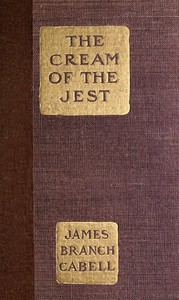
length
44,868 words
a few pages a day
~8 min
finished in
24 days
full read
3h 7m
At Folio's default of ten pages a day, you finish The Cream of the Jest in about 24 days — roughly 8 minutes of reading each morning.
The opening
the first pages of The Cream of the Jest, free
MUCH has been written critically about Felix Kennaston since the disappearance of his singular personality from the field of contemporary writers; and Mr. Froser’s Biography contains all it is necessary to know as to the facts of Kennaston’s life. Yet most readers of the Biography, I think, must have felt that the great change in Kennaston no long while after he “came to forty year”—this sudden, almost unparalleled, conversion of a talent for tolerable verse into the full-fledged genius of Men Who Loved Alison—stays, after all, unexplained....
Hereinafter you have Kennaston’s own explanation. I do not know but that in hunting down one enigma it raises a bevy; but it, at worst, tells from his standpoint honestly how this change came about.
You are to remember that the tale is pieced together, in part from social knowledge of the man, and in part from the notes I made as to what Felix Kennaston in person told me, bit by bit, a year or two after events the tale commemorates. I had known the Kennastons for some while, with that continual shallow intimacy into which chance forces most country people with their near neighbors, before Kennaston ever spoke of—as he called the thing—the sigil. And, even then, it was as if with negligence he spoke, telling of what happened—or had appeared to happen—and answering my questions, with simply dumbfounding personal unconcern. It all seemed indescribably indecent: and I marveled no little, I can remember, as I took my notes....
Now I can understand it was just that his standard of values was no longer ours nor really human. You see—it hardly matters through how dependable an agency—Kennaston no longer thought of himself as a man of flesh-and-blood moving about a world of his compeers. Or, at least, that especial aspect of his existence was to him no longer a phase of any particular importance.
But to tell of his thoughts, is to anticipate. Hereinafter you have them full measure and, such as it is, his story. You must permit that I begin it in my own way, with what may to you at first seem dream-stuff. For I commence at Storisende, in the world’s youth, when the fourth Count Emmerick reigned in Poictesme, having not yet blundered into the disfavor of his papal cousin Adrian VII.... With such roundabout gambits alone can some of us approach—as one fancy begets another, if you will—to proud assurance that life is not a blind and aimless business; not all a hopeless waste and confusion; and that we ourselves may (by-and-by) be strong and excellent and wise.
Such, in any event, is the road that Kennaston took, and such the goal to which he was conducted. So, with that goal in view, I also begin where he began, and follow whither the dream led him. Meanwhile, I can but entreat you to remember it is only by preserving faith in human dreams that we may, after all, perhaps some day make them come true.
RICHARD FENTNOR HARROWBY.
Montevideo 14 April 1917.
------------------------------------------------------------------------
Book First
══════════════════════
“Give place, fair ladies, and begone, Ere pride hath had a fall! For here at hand approacheth one Whose grace doth stain you all.
“Ettarre is well compared Unto the Phœnix kind, Whose like was never seen or heard, That any man can find.”
══════════════════════
------------------------------------------------------------------------
I
Introduces the Ageless Woman
THE tale tells how Count Emmerick planned a notable marriage-feast for his sister La Beale Ettarre and Sir Guiron des Rocques. The tale relates that, in honor of this wedding, came from Nacumera, far oversea, Count Emmerick’s elder sister Dame Melicent and her husband the Comte de la Forêt, with an outlandish retinue of pagan slaves that caused great wonder. All Poictesme took holiday. The tale narrates how from Naimes to Lisuarte, and in the wild hill-country back of Perdigon, knights made ready for the tournament, traveling toward Storisende in gay silken garments such as were suited to these new times of peace. The highways in those parts shone with warriors, riding in companies of six or eight, wearing mantles worked in gold, and mounted upon valuable horses that glittered with new bits and housings. And the tale tells, also, how they came with horns sounding before them.
Keep going from exactly here — Folio remembers your place and serves the next portion tomorrow.
continue reading The Cream of the JestAbout this free edition
The Cream of the Jest by James Branch Cabell (1879-1958) is free to read in full. Folio serves it in daily portions you can actually finish, tracks your streak and reading position across devices, and reads every page aloud with a built-in narrator. The text comes from Project Gutenberg.
More like The Cream of the Jest
Jurgen: A Comedy of Justice
Folio
Jurgen: A Comedy of Justice
James Branch Cabell
Figures of Earth
Folio
Figures of Earth
James Branch Cabell
The Eagle's Shadow
Folio
The Eagle's Shadow
James Branch Cabell
The Line of Love; Dizain des Mariages
Folio
The Line of Love; Dizain des Mariages
James Branch Cabell
Domnei: A Comedy of Woman-Worship
Folio
Domnei: A Comedy of Woman-Worship
James Branch Cabell
The Time Machine
H. G. Wells
The War of the Worlds
H. G. Wells
The Invisible Man
H. G. Wells