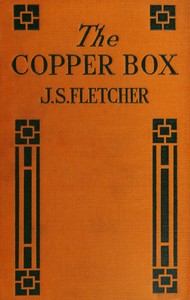
length
35,824 words
a few pages a day
~8 min
finished in
19 days
full read
2h 29m
At Folio's default of ten pages a day, you finish The copper box in about 19 days — roughly 8 minutes of reading each morning.
The opening
the first pages of The copper box, free
Although it was springtide by the calendar, and already some little way advanced, the snow time was by no means over in that wild Border country. The exact date was April 19. I fix it by the fact that my birthday falls on the 18th, and that I spent that one, the twenty-third, in an old-fashioned hotel at Wooler, and celebrated it by treating myself at dinner to the best bottle of wine the house afforded. It may have been the bottle of wine--but more likely it was sheer ignorance and presumption--that prompted me next morning to attempt what proved to be an impossible feat of pedestrianism. I set out immediately after breakfast intending before nightfall to make a complete circuit of the country which lies between Wooler and the Scottish border, going round by Kirknewton, Coldburn, and the Cheviot, and getting back to my starting-point by Hedgehope Hill and Kelpie Strand. That would have been a big walk on a long and fair summer day; in the uncertainty of a northern April it was a rash venture, which landed me in a highly unpleasant situation before the close of the afternoon. The morning was bright and promising, and for many enjoyable hours all went well. But about three o’clock came a disappearance of the sun and a suspicious darkening of the sky and lowering of temperature; before long snow began to fall, and in a fashion with which I, a Southerner, was not at all familiar. It was thick, it was blinding, it was persistent; it speedily obscured tracks, and heaped itself up in hollows; I began to have visions of being lost in it. And between five and six o’clock I found myself in this position--as far as I could make out from my pocket-map, I was at some point of the Angle between the Cheviot, Cairn Hill, and Hedgehope Hill and at the western extremity of Harthope Burn, but for all practical purposes I might as well have been in the heart of the Andes. I could just make out the presence of the three great hills, but I could see nothing of any farmstead or dwelling; what was worse, no house, wayside inn, or village was marked on my map--that is, within any reasonable distance. As for a path, I had already lost the one I was on, and the snow by that time had become a smooth thick white carpet in front of me; I might be safe in stepping farther on that carpet, and I might sink into a hole or bog and be unable to get out. And the nearest indicated place--Middleton--was miles and miles away, and darkness was coming, and coming quickly.
The exact spot in which I made these rough reckonings was at the lee side of a coppice of young fir, whereat I had paused to rest a while and to consider what was best to be done. Clearly, there was only one thing to do!--to struggle on and trust to luck. I prepared for that by taking a pull at my flask, in which, fortunately, there was still half its original contents of whisky and water left, and finishing the remains of my lunch. But the prospect that faced me when I presently left my shelter and rounded the corner of the coppice was by no means pleasant. The snow was falling faster and thicker, and darkness was surely coming. It looked as if I was either to struggle through the snow for more miles than I knew of, or be condemned to creep under any shelter I could find and pass a miserable night. But even then my bad luck was on the turn. Going onward and downward, from off the moorland towards the valley, I suddenly realised that I had struck some sort of road or made track; it was hard and wide, as I ascertained by striking my stick through the snow at various places. And just as suddenly, a little way farther to the east, I saw, bright and beckoning, the lights of a house.
The dusk was now so much fallen, and the whirling snow-flakes so thick that I had come right up to it before I could make out what manner of house it was that I had chanced upon so opportunely. It stood a little back from the road, on its north side, and in a sort of recess in the moorland, with the higher ground shelving down to its walls on all sides except that on which I stood. There was a courtyard all round it; on three sides of this the walls were unusually high, but on mine lower--low enough to enable me to see what stood inside. And that was as queer-looking a house as ever I had seen. Its centre was a high, square tower, with a battlemented head; from its west and east angles lower buildings projected--lower, yet of considerable height; at one of the angles of these wings, connecting it and the tower, there was a round turret, with a conical top--altogether the place was so mediæval in appearance that it made me think of marauding barons, cattle forays, and all the rest of it. That the house was ancient I gathered from one circumstance--there was not a window anywhere in its lower parts. These seemed to be of solid masonry, unpierced by window or door; the lights I had seen came from windows fifteen or twenty feet above the level of the courtyard--one in the round turret, one in the left wing, a third in the right.
Keep going from exactly here — Folio remembers your place and serves the next portion tomorrow.
continue reading The copper boxAbout this free edition
The copper box by J. S. Fletcher (1863-1935) is free to read in full. Folio serves it in daily portions you can actually finish, tracks your streak and reading position across devices, and reads every page aloud with a built-in narrator. The text comes from Project Gutenberg.
More like The copper box
The Paradise Mystery
Folio
The Paradise Mystery
J. S. Fletcher
The Middle Temple Murder
J. S. Fletcher

The Charing Cross Mystery
J. S. Fletcher
The Markenmore Mystery
J. S. Fletcher
The Orange-Yellow Diamond
Folio
The Orange-Yellow Diamond
J. S. Fletcher
Ravensdene Court
J. S. Fletcher
The Herapath Property
Folio
The Herapath Property
J. S. Fletcher
In the Mayor's Parlour
Folio
In the Mayor's Parlour
J. S. Fletcher