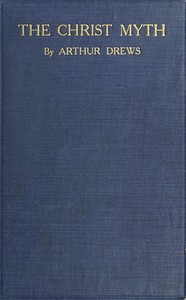
length
93,447 words
a few pages a day
~8 min
finished in
50 days
full read
6h 29m
At Folio's default of ten pages a day, you finish The Christ Myth in about 50 days — roughly 8 minutes of reading each morning.
The opening
the first pages of The Christ Myth, free
Since David Frederick Strauss, in his "Life of Jesus," attempted for the first time to trace the Gospel stories and accounts of miracles back to myths and pious fictions, doubts regarding the existence of an historical Jesus have never been lulled to rest. Bruno Bauer also in his "Kritik der evangelischen Geschichte und der Synoptiker" (1841-42, 2nd ed. 1846), [1] disputed the historical existence of Jesus; later, in his "Christ und die Cäsaren, der Ursprung des Christentums aus dem römischen Griechentum" (1877), he attempted to show that the life of Jesus was a pure invention of the first evangelist, Mark, and to account for the whole Christian religion from the Stoic and Alexandrine culture of the second century, ascribing to Seneca especially a material influence upon the development of the Christian point of view. But it was reserved for the present day, encouraged by the essentially negative results of the so-called critical theology, to take up the subject energetically, and thereby to attain to results even bolder and more startling.
In England John M. Robertson, in "Christianity and Mythology" (1900), in "A Short History of Christianity" (1902), as well as in his work "Pagan Christs: Studies in Comparative Hierology" (1903), has traced the picture of Christ in the Gospels to a mixture of mythological elements in heathenism and Judaism.
In France, as early as the end of the eighteenth century, Dupuis ("L'origine de tous les cultes," 1795) and Voltaire ("Les Ruines," 1791) traced back the essential points of the history of the Christian redemption to astral myths, while Émile Burnouf ("La science des religions," 4th ed., 1885) and Hochart ("Études d'histoire religieuse," 1890) collected important material for the clearing up of the origin of Christianity, and by their results cast considerable doubt upon the existence of an historical Christ.
In Italy Milesbo (Emilio Bossi) has attempted to prove the non-historicity of Jesus in his book "Gesù Christo non è mai esistito" (1904).
In Holland the Leyden Professor of Philosophy, Bolland, handled the same matter in a series of works ("Het Lijden en Sterven van Jezus Christus," 1907; "De Achtergrond der Evangeliën. Eene Bijdrage tot de kennis van de Wording des Christendoms," 1907; "De evangelische Jozua. Eene poging tot aanwijzing van den oorsprong des Christendoms," 1907).
In Poland the mythical character of the story of Jesus has been shown by Andrzej Niemojewski in his book "Bóg Jezus" (1909), which rests on the astral-mythological theories of Dupuis and the school of Winckler.
In Germany the Bremen Pastor Kalthoff, in his work, "Das Christusproblem, Grundlinien zu einer Sozialtheologie" (1903), thought that the appearance of the Christian religion could be accounted for without the help of an historical Jesus, simply from a social movement of the lower classes under the Empire, subsequently attempting to remove the one-sidedness of this view by his work "Die Entstehung des Christentums. Neue Beiträge zum Christusproblem" (1904). (Cf. also his work "Was wissen wir von Jesus? Eine Abrechnung mit Professor D. Bousset," 1904.) A supplement to the works of Kalthoff in question is furnished by Fr. Steudel in "Das Christusproblem und die Zukunft des Protestantismus" (Deutsche Wiedergeburt, 1909).
Finally, the American, William Benjamin Smith, in his work, "The Pre-Christian Jesus" (1906), has thrown so clear a light upon a number of important points in the rise of Christianity, and elucidated so many topics which give us a deeper insight into the actual correlation of events, that we gradually commence to see clearly in this connection.
Keep going from exactly here — Folio remembers your place and serves the next portion tomorrow.
continue reading The Christ MythAbout this free edition
The Christ Myth by Arthur Drews (1865-1935) is free to read in full. Folio serves it in daily portions you can actually finish, tracks your streak and reading position across devices, and reads every page aloud with a built-in narrator. The text comes from Project Gutenberg.
More like The Christ Myth
Meditations
Folio
Meditations
Marcus Aurelius
The Enchiridion
Epictetus
Thus Spake Zarathustra
Friedrich Nietzsche
Beyond Good and Evil
Folio
Beyond Good and Evil
Friedrich Nietzsche
The Genealogy of Morals
Folio
The Genealogy of Morals
Friedrich Nietzsche
The Republic
Folio
The Republic
Plato
Apology
Folio
Apology
Plato
Crito
Folio
Crito
Plato