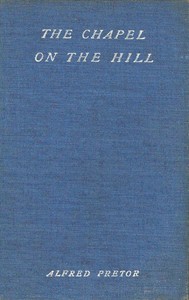
The Chapel on the Hill
free to read
length
32,554 words
a few pages a day
~8 min
finished in
18 days
full read
2h 16m
At Folio's default of ten pages a day, you finish The Chapel on the Hill in about 18 days — roughly 8 minutes of reading each morning.
The opening
the first pages of The Chapel on the Hill, free
To those, I think a lessening number, who may find themselves at variance with “my Rector’s” theology, I tender the following quotation from one of the ablest and deepest thinkers of the past century:
“If, instead of the ‘glad tidings’ that there exists a Being in whom all the excellences which the highest human mind can conceive exist in a degree inconceivable to us, I am informed that the world is ruled by a Being whose attributes are infinite, but what they are we cannot learn, nor what are the principles of his government, except that ‘the highest human morality which we are capable of conceiving’ does not sanction them; convince me of it, and I will bear my fate as I may. But when I am told that I must believe this, and at the same time call this Being by the names which express and affirm the highest human morality, I say in plain terms I will call no being good who is not what I mean when I apply that epithet to my fellow-creatures.”—J. S. MILL, Examination of Sir W. Hamilton’s Philosophy, pp. 102, 103 (Criticism of Mansel).
I have omitted from the above the author’s peroration, which is couched in language too strong to suit the taste of the present generation.
That the Bible is our one and only true guide, we believe; but we are nowhere instructed to make an idol and a fetish of the form in which it is presented. It was written to suit all times; we must read it in the language of to-day.
In the controversy between the Squire and himself the Rector is by no means guiltless of plagiarism. Ford, who knew Spain as intimately as an Englishman can ever know it, advances the self-same arguments in his comments on the national sport.
A word more and I have done. It is reported on good authority that one of our greatest divines—the author of ‘Butler’s Analogy’—held a confident belief in the re-existence of animals. They share our doom of suffering and death: why not our promise of happiness beyond? They have done nothing to forfeit their reward.
A. P.
CAMBRIDGE, August, 1904.
INTRODUCTION
RIVERDALE and I—to wit one Harold Stirling by name—had been close friends almost since life began, at our private school, our public school, and again at college. And we were meeting now for the last time as undergraduates in Riverdale’s rooms at Cambridge. For the choice that comes, once at any rate in a lifetime, to all, had come to us, and we had chosen divergent, to some it would appear antagonistic, careers.
To judge from his personal appearance, Riverdale at any rate had chosen wisely for himself when he elected to become an artist. Smoking at his ease, in a picturesque environment of flowers and ferns, pictures and statuettes, he looked like what he was—a well-to-do indolent dreamer, who might possibly succeed as a painter, but would never make much of life in any other line. Fortunately for him he had no need to trouble himself about the future. A kindly fate had settled all this in advance, when his only surviving relative, an uncle, had made him a comfortable allowance of a thousand a year, adding the still more comfortable assurance that the family estate of Riverdale should be his when the time came that he himself should have no further use for it.
Study him, as the glow from a reading-lamp falls full on his features, and you will say that his personality is concentrated in his eyes. Sapphire blue they would have been called by a casual observer, but it always seemed to me that they held in them a deeper tint, as of violet or purple. But whatever their colour, they are about as rare in humanity as is a blue rose or a green chrysanthemum among the creations of the floral world. Not that they betoken much character, I think. It is simply their beauty, and perhaps their rarity, that constitutes the attraction. At any rate, veiled by long lashes, and set in Italian features, as was the case with Riverdale, it is impossible to hold them indicative of energy or activity in life.
Keep going from exactly here — Folio remembers your place and serves the next portion tomorrow.
continue reading The Chapel on the HillAbout this free edition
The Chapel on the Hill by Alfred Pretor (1840-1908) is free to read in full. Folio serves it in daily portions you can actually finish, tracks your streak and reading position across devices, and reads every page aloud with a built-in narrator. The text comes from Project Gutenberg.
More like The Chapel on the Hill
Pride and Prejudice
Jane Austen
Sense and Sensibility
Jane Austen
Emma
Folio
Emma
Jane Austen
Persuasion
Folio
Persuasion
Jane Austen
Mansfield Park
Folio
Mansfield Park
Jane Austen
Jane Eyre
Charlotte Brontë
The Tenant of Wildfell Hall
Folio
The Tenant of Wildfell Hall
Anne Brontë
Agnes Grey
Folio
Agnes Grey
Anne Brontë