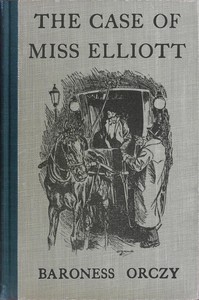
The case of Miss Elliott
free to read
length
66,195 words
a few pages a day
~8 min
finished in
35 days
full read
4h 36m
At Folio's default of ten pages a day, you finish The case of Miss Elliott in about 35 days — roughly 8 minutes of reading each morning.
The opening
the first pages of The case of Miss Elliott, free
[Frontispiece: A horse-drawn hansom cab at night-time. In the shadowy interior of the cab sits a man in evening dress, leaning against the side of the cab as if dozing. Another man stands beside the cab, tentatively reaching in. Caption: “’E was dead and no mistake.”]
I. The Case of Miss Elliott
Chapter I
The man in the corner was watching me over the top of his great bone-rimmed spectacles.
“Well?” he asked, after a little while.
“Well?” I repeated with some acerbity. I had been wondering for the last ten minutes how many more knots he would manage to make in that same bit of string, before he actually started undoing them again.
“Do I fidget you?” he asked apologetically, whilst his long bony fingers buried themselves, string, knots, and all, into the capacious pockets of his magnificent tweed ulster.
“Yes, that is another awful tragedy,” he said quietly, after a while. “Lady doctors are having a pretty bad time of it just now.”
This was only his usual habit of speaking in response to my thoughts. There was no doubt that at the present moment my mind was filled with that extraordinary mystery which was setting all Scotland Yard by the ears, and had completely thrown into the shade the sad story of Miss Hickman’s tragic fate.
The Daily Telegraph had printed two columns headed “Murder or Suicide?” on the subject of the mysterious death of Miss Elliott, matron of the Convalescent Home, in Suffolk Avenue—and I must confess that a more profound and bewildering mystery had never been set before our able detective department.
“It has puzzled them this time, and no mistake,” said the man in the corner, with one of his most gruesome chuckles, “but I daresay the public is quite satisfied that there is no solution to be found, since the police have found none.”
“Can you find one?” I retorted with withering sarcasm.
“Oh, my solution would only be sneered at,” he replied. “It is far too simple—and yet how logical! There was Miss Elliott, a good-looking, youngish, lady-like woman, fully qualified in the medical profession and in charge of the Convalescent Home in Suffolk Avenue, which is a private institution largely patronised by the benevolent.
“For some time, already, there had appeared vague comments and rumours in various papers, that the extensive charitable contributions did not all go towards the up-keep of the Home. But, as is usual in institutions of that sort, the public was not allowed to know anything very definite, and contributions continued to flow in, whilst the Honorary Treasurer of the great Convalescent Home kept up his beautiful house in Hamilton Terrace, in a style which would not have shamed a peer of the realm.
“That is how matters stood, when on 2nd November last the morning papers contained the brief announcement that at a quarter past midnight two workmen walking along Blomfield Road, Maida Vale, suddenly came across the body of a young lady, lying on her face, close to the wooden steps of the narrow foot-bridge which at this point crosses the canal.
“This part of Maida Vale is, as you know, very lonely at all times, but at night it is usually quite deserted. Blomfield Road, with its row of small houses and bits of front gardens, faces the canal, and beyond the foot-bridge is continued in a series of small riverside wharves, which is practically unknown ground to the average Londoner. The foot-bridge itself, with steps at right angles and high wooden parapet, would offer excellent shelter at all hours of the night for any nefarious deed.
“It was within its shadows that the men had found the body, and to their credit be it said, they behaved like good and dutiful citizens—one of them went off in search of the police, whilst the other remained beside the corpse.
Keep going from exactly here — Folio remembers your place and serves the next portion tomorrow.
continue reading The case of Miss ElliottAbout this free edition
The case of Miss Elliott by Emmuska Orczy (1865-1947) is free to read in full. Folio serves it in daily portions you can actually finish, tracks your streak and reading position across devices, and reads every page aloud with a built-in narrator. The text comes from Project Gutenberg.
More like The case of Miss Elliott

The man in grey
Emmuska Orczy

Unravelled Knots
Emmuska Orczy
Lady Molly of Scotland Yard
Emmuska Orczy
The Elusive Pimpernel
Folio
The Elusive Pimpernel
Emmuska Orczy
The League of the Scarlet Pimpernel
Folio
The League of the Scarlet Pimpernel
Emmuska Orczy
Castles in the Air
Folio
Castles in the Air
Emmuska Orczy
A Bride of the Plains
Folio
A Bride of the Plains
Emmuska Orczy
Petticoat Rule
Folio
Petticoat Rule
Emmuska Orczy