length
139,788 words
a few pages a day
~8 min
finished in
74 days
full read
9h 42m
At Folio's default of ten pages a day, you finish The case against evolution in about 74 days — roughly 8 minutes of reading each morning.
The opening
the first pages of The case against evolution, free
Obvious typographical errors have been silently corrected. Variations in hyphenation have been standardised but all other spelling, punctuation and accents remains unchanged.
Italics are represented thus italic, bold thus =bold=.
A reference to Monism as “destructive of culture, etc.” in the index to page 450, which does not exist, has been changed to 350.
The repetition of section titles on consecutive pages has been removed.
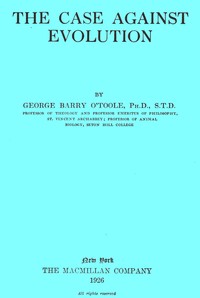
THE CASE AGAINST EVOLUTION
[publisher’s monogram]
THE MACMILLAN COMPANY NEW YORK · BOSTON · CHICAGO · DALLAS ATLANTA · SAN FRANCISCO
MACMILLAN & CO., LIMITED LONDON · BOMBAY · CALCUTTA MELBOURNE
THE MACMILLAN CO. OF CANADA, LTD. TORONTO
THE CASE AGAINST EVOLUTION
BY
GEORGE BARRY O’TOOLE, PH. D., S.T.D.
PROFESSOR OF THEOLOGY AND PROFESSOR EMERITUS OF PHILOSOPHY, ST. VINCENT ARCHABBEY; PROFESSOR OF ANIMAL BIOLOGY, SETON HILL COLLEGE
New York
THE MACMILLAN COMPANY
1926
All rights reserved
COPYRIGHT, 1925, BY THE MACMILLAN COMPANY.
Set up and electrotyped. Published April, 1925.
Reprinted February, 1926.
Printed in the United States of America by J. J. LITTLE AND IVES COMPANY, NEW YORK
TO MY MOTHER
ADDENDA
NOTE TO PAGE 23.—
As a result of recent investigations on the sex chromosomes and chromosome numbers in mammals, Theophilus S. Painter reaches the conclusions that polyploidy cannot be invoked to explain evolution within this class. After giving a table of chromosome numbers for 7 out of the 9 eutherian orders, Painter concludes: “The facts recorded above are of especial interest in that they indicate a unity of chromosome composition above the marsupial level and effectively dispose of the suggestion that extensive polyploidy may have occurred within this subclass.
“In the marsupials the chromosome number is a low one and in the opossum is 22. At first sight it might appear that the eutherian condition might have arisen from this by tetraploidy. There are two objections, however. In the first place the bulk of the chromatin in marsupials is about the same as in the eutheria, using the sex chromosome as our measure. In the second place, polyploidy could scarcely occur successfully in animals with X-Y sex chromosomes, as most mammals possess, because of the complication occurring in the sex chromosome balance” (Science, April 17, 1925, p. 424). As the X-Y type of sex chromosomes occurs widely not only among vertebrates, but also among insects, nematodes, and echinoderms, Painter’s latter objection excludes evolution by polyploidy from a large portion of the animal kingdom.
NOTE TO PAGE 90.—
Keep going from exactly here — Folio remembers your place and serves the next portion tomorrow.
continue reading The case against evolutionAbout this free edition
The case against evolution by George Barry O'Toole (1886-1944) is free to read in full. Folio serves it in daily portions you can actually finish, tracks your streak and reading position across devices, and reads every page aloud with a built-in narrator. The text comes from Project Gutenberg.
More like The case against evolution
Meditations
Folio
Meditations
Marcus Aurelius
The Enchiridion
Epictetus

Thus Spake Zarathustra
Friedrich Nietzsche
Beyond Good and Evil
Folio
Beyond Good and Evil
Friedrich Nietzsche
The Genealogy of Morals
Folio
The Genealogy of Morals
Friedrich Nietzsche
The Republic
Folio
The Republic
Plato
Apology
Folio
Apology
Plato
Crito
Folio
Crito
Plato