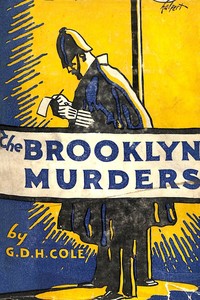
The Brooklyn murders
free to read
length
100,949 words
a few pages a day
~8 min
finished in
54 days
full read
7h 1m
At Folio's default of ten pages a day, you finish The Brooklyn murders in about 54 days — roughly 8 minutes of reading each morning.
The opening
the first pages of The Brooklyn murders, free
At seventy Sir Vernon Brooklyn was still the outstanding figure in the theatrical world. It was, indeed, ten years since he had made his farewell appearance on the stage; and with a consistency rare among the members of his profession, he had persisted in making his first farewell also his last. He had also for some time past resigned to younger men the actual direction of his vast theatrical enterprises, which included five great West End theatres and a steady stream of touring companies in the provinces and overseas. Both as actor and as manager, he was wont to say, his work was over; but as Chairman of the Brooklyn Dramatic Corporation, which conducted all its work under his name, he was almost as much as ever in the eye of the public.
Like most men who have risen by their own efforts, aided by fortune and by a public which takes a pleasure in idolatry, to positions of wide authority, Sir Vernon had developed, perhaps to excess, the habit of getting his own way. Thus, although his niece and house-keeper, Joan Cowper, and his near relatives and friends had done their best to dissuade him from coming to London, he had ignored their protests, and insisted on celebrating his seventieth birthday in the London house, formerly the scene of his triumphs, which he now seldom visited. Sir Vernon now spent most of his time at the great country house in Sussex which he had bought ten years before from Lord Fittleworth. There he entertained largely, and there was no reason why he should not have taken the advice of his relatives and his doctor, and gathered his friends around him to celebrate what he was pleased to call his “second majority.” But Sir Vernon had made up his mind, and it was therefore in the old house just off Piccadilly that his guests assembled for dinner on Midsummer Day, June 25th.
Like Sir Vernon’s country place, the old house had a history. He had bought it, and the grounds with their magnificent garden frontage on Piccadilly, looking over the Green Park, from Lord Liskeard, when that nobleman had successfully gambled away the fortune which had made him, at one time, the richest man in England who had no connection with trade. Sir Vernon had turned his purchase to good use. Facing Piccadilly, but standing well back in its garden from the street, he had built the great Piccadilly Theatre, the perfect playhouse in which, despite its size and large seating capacity, every member of the audience could both see and hear. The theatre covered a lot of ground; but, when it was built, there still remained not only the old mansion fronting upon its side-street—a cul de sac used by its visitors alone—but also, between it and the theatre, a pleasant expanse of garden. For some years Sir Vernon had lived in the house; and there he had also worked, converting the greater part of the ground floor into a palatial set of offices for the Brooklyn Dramatic Corporation. On his retirement from active work, he had kept in his own hands only the first floor, which he fitted as a flat to house him on his visits to town. On the second floor he had installed his nephew, John Prinsep, who had succeeded him as managing director of the Corporation. The third floor was given over to the servants who attended to the whole house. It was in this house that Sir Vernon was celebrating his birthday, and his guests were to dine with him in the great Board Room of the Corporation on the ground floor—formerly the banqueting hall of generations of Liskeards, in which many a political plot had been hatched, and many a diner carried helpless from under the table in the bad days of the Prince Regent.
Between the house and the tall back of the theatre lay the garden, in which a past Lord Liskeard with classical tastes had erected a model Grecian temple and a quantity of indifferent antique statuary, the fruits of his sojourn at the Embassy of Constantinople.
In this garden, before dinner was served, a number of Sir Vernon’s guests had already gathered. The old man had been persuaded, despite the brilliant midsummer weather, to remain in the house; but Joan Cowper and John Prinsep were there to do the honours on his behalf. As Harry Lucas came into the garden, John Prinsep was laughingly, as he said, “showing off the points” of a dilapidated Hercules who, club, lion-skin and all, was slowly mouldering under the trees at one end of the lawn. The stone club had come loose, and Prinsep had taken it from the statue, and was playfully threatening to do classical execution with it upon the persons of his guests. Seeing Lucas, he put the club back into the broken hand of the statue, and came across the lawn to bid him welcome.
“You’re the last to arrive, Mr. Lucas,” said he. “You see it’s quite a family affair this evening.”
Keep going from exactly here — Folio remembers your place and serves the next portion tomorrow.
continue reading The Brooklyn murdersAbout this free edition
The Brooklyn murders by G. D. H. Cole (1889-1959) is free to read in full. Folio serves it in daily portions you can actually finish, tracks your streak and reading position across devices, and reads every page aloud with a built-in narrator. The text comes from Project Gutenberg.
More like The Brooklyn murders
The Adventures of Sherlock Holmes
Arthur Conan Doyle
The Hound of the Baskervilles
Arthur Conan Doyle
A Study in Scarlet
Folio
A Study in Scarlet
Arthur Conan Doyle
The Sign of the Four
Arthur Conan Doyle
The Memoirs of Sherlock Holmes
Arthur Conan Doyle
The Return of Sherlock Holmes
Arthur Conan Doyle
His Last Bow
Arthur Conan Doyle
The Valley of Fear
Arthur Conan Doyle