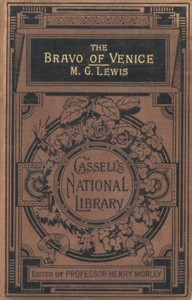
length
34,028 words
a few pages a day
~8 min
finished in
18 days
full read
2h 22m
At Folio's default of ten pages a day, you finish The Bravo of Venice: A Romance in about 18 days — roughly 8 minutes of reading each morning.
The opening
the first pages of The Bravo of Venice: A Romance, free
MATTHEW GREGORY LEWIS, who professed to have translated this romance out of the German, very much, I believe, as Horace Walpole professed to have taken The Castle of Otranto from an old Italian manuscript, was born in 1775 of a wealthy family. His father had an estate in India and a post in a Government office. His mother was daughter to Sir Thomas Sewell, Master of the Rolls in the reign of George III. She was a young mother; her son Matthew was devoted to her from the first. As a child he called her “Fanny,” and as a man held firmly by her when she was deserted by her husband. From Westminster School, M. G. Lewis passed to Christ Church, Oxford. Already he was busy over tales and plays, and wrote at college a farce, never acted, a comedy, written at the age of sixteen, The East Indian, afterwards played for Mrs. Jordan’s benefit and repeated with great success, and also a novel, never published, called The Effusions of Sensibility, which was a burlesque upon the sentimental school. He wrote also what he called “a romance in the style of The Castle of Otranto,” which appeared afterwards as the play of The Castle Spectre.
With his mind thus interested in literature of the romantic form, young Lewis, aged seventeen, after a summer in Paris, went to Germany, settled for a time at Weimar, and, as he told his mother, knocked his brains against German as hard as ever he could. “I have been introduced,” he wrote, in July, 1792, “to M. de Goethe, the celebrated author of Werter, so you must not be surprised if I should shoot myself one of these fine mornings.” In the spring of 1793 the youth returned to England, very full of German romantic tale and song, and with more paper covered with wild fancies of his own. After the next Christmas he returned to Oxford. There was a visit to Lord Douglas at Bothwell Castle; there was not much academic work done at Oxford. His father’s desire was to train him for the diplomatic service, and in the summer of 1794 he went to the Hague as attaché to the British Embassy. He had begun to write his novel of The Monk, had flagged, but was spurred on at the Hague by a reading of Mrs. Radcliffe’s Mysteries of Udolpho, a book after his own heart, and he wrote to his mother at this time, “You see I am horribly bit by the rage of writing.”
The Monk was written in ten weeks, and published in the summer of 1795, before its author’s age was twenty. It was praised, attacked, said by one review to have neither originality, morals, nor probability to recommend it, yet to have excited and to be continuing to excite the curiosity of the public: a result set down to the “irresistible energy of genius.” Certainly, Lewis did not trouble himself to keep probability in view; he amused himself with wild play of a fancy that delighted in the wonderful. The controversy over The Monk caused the young author to be known as Monk Lewis, and the word Monk has to this day taken the place of the words Matthew Gregory so generally, that many catalogue-makers must innocently suppose him to have been so named at the font. The author of The Monk came back from the Hague to be received as a young lion in London society. When he came of age he entered Parliament for Hindon, in Wiltshire, but seldom went to the House, never spoke in it, and retired after a few sessions. His delight was in the use of the pen; his father, although disappointed by his failure as a statesman, allowed him a thousand a year, and he took a cottage at Barnes, that he might there escape from the world to his ink-bottle. He was a frequent visitor at Inverary Castle, and was fascinated by his host’s daughter, Lady Charlotte Campbell. Still he wrote on. The musical drama of The Castle Spectre was produced in the year after The Monk, and it ran sixty nights. He translated next Schiller’s Kabale und Liebe as The Minister, but it was not acted till it appeared, with little success, some years afterwards at Covent Garden as The Harper’s Daughter. He translated from Kotzebue, under the name of Rolla, the drama superseded by Sheridan’s version of the same work as Pizarro. Then came the acting, in 1799, of his comedy written in boyhood, The East Indian. Then came, in the same year, his first opera, Adelmorn the Outlaw; then a tragedy, Alfonso, King of Castile. Of the origin of this tragedy Lewis gave a characteristic account. “Hearing one day,” he said, “my introduction of negroes into a feudal baron’s castle” (in The Castle Spectre) “exclaimed against with as much vehemence as if a dramatic anachronism had been an offence undeserving of benefit of clergy, I said in a moment of petulance, that to prove of how little consequence I esteemed such errors, I would make a play upon the Gunpowder Plot, and make Guy Faux in love with the Emperor Charlemagne’s daughter. By some chance or other, this idea fastened itself upon me, and by dint of turning it in my mind, I at length formed the plot of Alfonso.”
Keep going from exactly here — Folio remembers your place and serves the next portion tomorrow.
continue reading The Bravo of Venice: A RomanceAbout this free edition
The Bravo of Venice: A Romance by Heinrich Zschokke (1771-1848) is free to read in full. Folio serves it in daily portions you can actually finish, tracks your streak and reading position across devices, and reads every page aloud with a built-in narrator. The text comes from Project Gutenberg.
More like The Bravo of Venice: A Romance
The Broken Cup
Folio
The Broken Cup
Heinrich Zschokke
Dracula
Bram Stoker
The Strange Case of Dr. Jekyll and Mr. Hyde
Robert Louis Stevenson
The Turn of the Screw
Folio
The Turn of the Screw
Henry James

The Picture of Dorian Gray
Oscar Wilde
The Fall of the House of Usher
Folio
The Fall of the House of Usher
Edgar Allan Poe
Carmilla
Joseph Sheridan Le Fanu
Uncle Silas
Folio
Uncle Silas
Joseph Sheridan Le Fanu