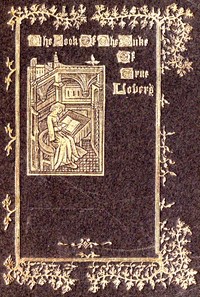
length
31,669 words
a few pages a day
~8 min
finished in
17 days
full read
2h 12m
At Folio's default of ten pages a day, you finish The Book of the Duke of True Lovers in about 17 days — roughly 8 minutes of reading each morning.
The opening
the first pages of The Book of the Duke of True Lovers, free
The only two known MSS., both early fifteenth century French, of the love-story here rendered into English prose, are the one in the Bibliotheque Nationale (836), and that in the British Museum (Harley, 4431).
The MS. in the Bibliotheque Nationale forms one of the treasures of the famous collection of MSS. made by Jean, Duc de Berry, the Mecaenas of illuminated MSS. At his death it passed into the possession of his daughter Marie, who, by marriage, had become Duchesse de Bourbon. When, in the reign of Francois I., the Connetable de Bourbon, to whom it had descended, was disgraced, the king seized his books and MSS., and carried them off to Fontainebleau, well pleased to add by any means, righteous or unrighteous, to the treasures of the royal library. Here this MS. and others remained until the reign of Charles IX., when they were removed to Paris, and placed in the Bibliotheque du Roi, now the world-famous Bibliotheque Nationale.
The MS. in the British Museum has also had an interesting and chequered career. It was originally presented by Christine de Pisan to Isabelle of Bavaria, the queen of Charles VI. of France, whose books and MSS. were, in 1425, acquired by John, Duke of Bedford, Regent of France. It is more than probable that this MS. was amongst these and was brought to England, for the various signatures on the enclosing parchment would certainly seem to indicate that this was the case. Late in the fifteenth century the MS. was sold to one of the most celebrated bibliophiles of the day, Louis of Bruges. After this, there is a blank in its history, until, in the seventeenth century, we find it once more in England, in the possession of Henry, Duke of Newcastle, whose grand-daughter married Edward Harley, Earl of Oxford, the founder of the splendid collection of MSS. and books purchased in 1754 for the British Museum, and now known as the Harleian Collection.
The writer of the story, Christine de Pisan, was one of the world's many famous women, and one who, by her life and work, created an ideal for womankind--that of sweetness and strength. Born in Venice in 1363, she was, when five years of age, taken by her mother to Paris, to join her father, Thomas de Pisan, who had been summoned thither by the king, Charles V., to serve as his astrologer, in which service he remained until the king's death. The Court of Charles V. was, in spite of the constant warfare that troubled his kingdom, at once most cultured and refined, and it was in such surroundings that Christine was brought up. At the age of fifteen she was married to the king's notary and secretary, Etienne de Castel, a gentleman of Picardy, who, however, died some ten years later, leaving her with three children to provide for. Like many another, she turned to letters as both a material and a mental support. She wrote not only purely lyrical poetry, of extraordinary variety and abundance considering that the subject is almost invariably the joys and sorrows of love, sometimes, as she tells us, expressing her own sentiments, sometimes those of others at whose request she wrote, but she also wrote sacred and scientific poems, and moral and political prose works, and a kind of romantic fiction, of which the story of The Duke of True Lovers is an example, although it is quite possible, and indeed probable, that it has some historic basis.
Christine begins her story by saying that it had been confided to her by a young prince who did not wish his name to be divulged, and who desired only to be known as The Duke of True Lovers. It has been suggested, with much likelihood, that this is the love story of Jean, Duc de Bourbon, and Marie, Duchesse de Berry, who has already been alluded to as the daughter of the famous Jean, Duc de Berry, and the inheritor of his MSS. This Marie had been married, when quite a child, to Louis III. de Chatillon, Comte de Dunois, and afterwards to Philippe d'Artois, Comte d'Eu, Constable of France, whose wife she was at the time when the incidents which have been woven into this story are supposed to have taken place. Philippe d'Artois only survived the marriage three or four years, and after three years of widowhood, the already much-married Marie wedded (1400) our hero, Jean, Duc de Bourbon.
Keep going from exactly here — Folio remembers your place and serves the next portion tomorrow.
continue reading The Book of the Duke of True LoversAbout this free edition
The Book of the Duke of True Lovers by de Pisan Christine (1364?-1431?) is free to read in full. Folio serves it in daily portions you can actually finish, tracks your streak and reading position across devices, and reads every page aloud with a built-in narrator. The text comes from Project Gutenberg.
More like The Book of the Duke of True Lovers
Pride and Prejudice
Jane Austen
Sense and Sensibility
Jane Austen
Emma
Folio
Emma
Jane Austen
Persuasion
Folio
Persuasion
Jane Austen
Mansfield Park
Folio
Mansfield Park
Jane Austen
Jane Eyre
Charlotte Brontë
The Tenant of Wildfell Hall
Folio
The Tenant of Wildfell Hall
Anne Brontë
Agnes Grey
Folio
Agnes Grey
Anne Brontë