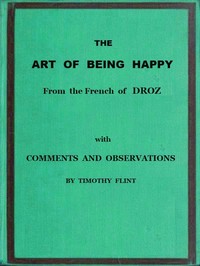
The Art of Being Happy
free to read
length
96,414 words
a few pages a day
~8 min
finished in
51 days
full read
6h 42m
At Folio's default of ten pages a day, you finish The Art of Being Happy in about 51 days — roughly 8 minutes of reading each morning.
The opening
the first pages of The Art of Being Happy, free
E-text prepared by John Campbell and the Online Distributed Proofreading Team (http://www.pgdp.net) from page images generously made available by Internet Archive (https://archive.org)
Note: Images of the original pages are available through Internet Archive. See https://archive.org/details/artofbeinghappy00droz
Transcriber’s note:
Text enclosed by underscores is in italics (italics).
There are about seventy Notes at the back of the book. These are referenced in the text by a numeric anchor eg [1] or [15]; some anchors have an ‘a’ suffix eg [15a] or [21a].
There are two Footnotes in the main text, whose anchors are [A] and [B]. There are six Footnotes in the Notes section, whose anchors are [C] to [H]. All eight Footnotes have been placed at the back of the book after the Notes section.
Numerous minor text changes are noted in the Transcriber’s Note at the end of the book.
THE ART OF BEING HAPPY:
From the French of DROZ,
‘SUR L’ART D’ETRE HEUREUX;’
In a Series of Letters from a Father to His Children: with Observations and Comments.
by
TIMOTHY FLINT.
‘----sua si bonna nôrint.’--VIRGIL.
Boston, Published By Carter And Hendee. 1832.
Entered according to Act of Congress, in the year 1832, BY CARTER AND HENDEE, in the Clerk’s Office of the District Court of Massachusetts.
ADVERTISEMENT.
The text, upon which the following observations and comments are based, does not assume to be a literal translation of the celebrated work of Droz. The original is strongly idiomatic; and the author has carried an uncommon talent of being laconic sometimes to the point of obscurity. I have often found it impossible to convey to the English reader a sentiment, perfectly obvious in the original, in as few words as are there used. The French, in its more numerous articles, more allowable and bold personifications, and arbitrary use of gender, has, in the hand of certain writers, this advantage over our language. When the doctrines of the book are compared one with the other, and each with the general bearing of the work, the inculcation, namely, of the truth that virtue is happiness, there will be found nothing immoral or reprehensible in it. The author, on the whole, leans to the Epicurean philosophy. Unfavorable, though erroneous impressions have been very generally entertained of that philosophy. In deference to that opinion, I have altogether omitted the few sentences, which seemed appropriate to some of the dogmas of the Epicureans. Nothing can be more remote from their alleged impiety, than the general tenor of this work. One of its most eloquent and impressive chapters is that upon religion. There is a distinct class in France, both numerous and important, the literatures. Many of the remarks of the author, bearing chiefly upon that class, seemed inapplicable, or unintelligible in our country, where there is no such class to address. I have passed over many passages and parts of chapters, which had an almost exclusive reference to persons in that walk in life. I have added members of sentences, and even whole sentences to the text, where such additions seemed necessary to develope the doctrine to an English reader.
Keep going from exactly here — Folio remembers your place and serves the next portion tomorrow.
continue reading The Art of Being HappyAbout this free edition
The Art of Being Happy by Joseph Droz (1773-1850) is free to read in full. Folio serves it in daily portions you can actually finish, tracks your streak and reading position across devices, and reads every page aloud with a built-in narrator. The text comes from Project Gutenberg.
More like The Art of Being Happy
Meditations
Folio
Meditations
Marcus Aurelius

The Enchiridion
Epictetus

Thus Spake Zarathustra
Friedrich Nietzsche
Beyond Good and Evil
Folio
Beyond Good and Evil
Friedrich Nietzsche
The Genealogy of Morals
Folio
The Genealogy of Morals
Friedrich Nietzsche
The Republic
Folio
The Republic
Plato
Apology
Folio
Apology
Plato
Crito
Folio
Crito
Plato