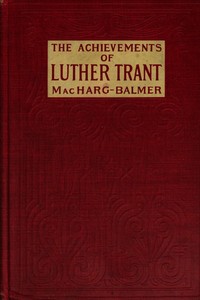
The achievements of Luther Trant
free to read
length
97,348 words
a few pages a day
~8 min
finished in
52 days
full read
6h 46m
At Folio's default of ten pages a day, you finish The achievements of Luther Trant in about 52 days — roughly 8 minutes of reading each morning.
The opening
the first pages of The achievements of Luther Trant, free
[Illustration: A gentleman seated in an armchair looks on in consternation at a man standing before him with a placid expression. Surrounding them are three other gentlemen and a lady, all studying the seated gentleman carefully.]
Caption: “I do not know him,” Axton’s eyes glanced furtively about. “I have never seen him before. This is not Lawler.” (See “The Axton Letters”)
FOREWORD
Except for its characters and plot, this book is not a work of the imagination.
The methods which the fictitious Trant—one time assistant in a psychological laboratory, now turned detective—here uses to solve the mysteries which present themselves to him, are real methods; the tests he employs are real tests.
Though little known to the general public, they are precisely such as are being used daily in the psychological laboratories of the great universities—both in America and Europe—by means of which modern men of science are at last disclosing and defining the workings of that oldest of world-mysteries—the human mind.
The facts which Trant uses are in no way debatable facts; nor do they rest on evidence of untrained, imaginative observers. Innumerable experiments in our university laboratories have established beyond question that, for instance, the resistance of the human body to a weak electric current varies when the subject is frightened or undergoes emotion; and the consequent variation in the strength of the current, depending directly upon the amount of emotional disturbance, can be registered by the galvanometer for all to see. The hand resting upon an automatograph will travel toward an object which excites emotion, however capable its possessor may be of restraining all other evidence of what he feels.
If these facts are not used as yet except in the academic experiments of the psychological laboratories and the very real and useful purpose to which they have been put in the diagnosis of insanities, it is not because they are incapable of wider use. The results of the “new psychology” are coming every day closer to an exact interpretation. The hour is close at hand when they will be used not merely in the determination of guilt and innocence, but to establish in the courts the credibility of witnesses and the impartiality of jurors, and by employers to ascertain the fitness and particular abilities of their employees.
Luther Trant, therefore, nowhere in this book needs to invent or devise an experiment or an instrument for any of the results he here attains; he has merely to adapt a part of the tried and accepted experiments of modern, scientific psychology. He himself is a character of fiction; but his methods are matters of fact.
The Authors.
CHAPTER I
The Man in the Room
“Amazing, Trant.”
“More than merely amazing! Face the fact, Dr. Reiland, and it is astounding, incredible, disgraceful, that after five thousand years of civilization, our police and court procedures recognize no higher knowledge of men than the first Pharaoh put into practice in Egypt before the pyramids!”
Young Luther Trant ground his heel impatiently into the hoar frost on the campus walk. His queerly mismated eyes—one more gray than blue, the other more blue than gray—flashed at his older companion earnestly. Then, with the same rebellious impatience, he caught step once more with Reiland, as he went on in his intentness:
Keep going from exactly here — Folio remembers your place and serves the next portion tomorrow.
continue reading The achievements of Luther TrantAbout this free edition
The achievements of Luther Trant by Edwin Balmer (1883-1959) is free to read in full. Folio serves it in daily portions you can actually finish, tracks your streak and reading position across devices, and reads every page aloud with a built-in narrator. The text comes from Project Gutenberg.
More like The achievements of Luther Trant
Decidedly Odd
Edwin Balmer
Keeban
Edwin Balmer
The Adventures of Sherlock Holmes
Arthur Conan Doyle
The Hound of the Baskervilles
Arthur Conan Doyle
A Study in Scarlet
Folio
A Study in Scarlet
Arthur Conan Doyle
The Sign of the Four
Arthur Conan Doyle
The Memoirs of Sherlock Holmes
Arthur Conan Doyle
The Return of Sherlock Holmes
Arthur Conan Doyle