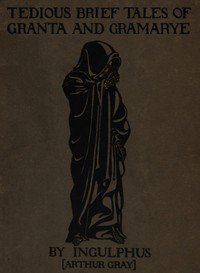
Tedious Brief Tales of Granta and Gramarye
first published 1919 · free to read
length
30,226 words
a few pages a day
~8 min
finished in
16 days
full read
2h 6m
At Folio's default of ten pages a day, you finish Tedious Brief Tales of Granta and Gramarye in about 16 days — roughly 8 minutes of reading each morning.
The opening
the first pages of Tedious Brief Tales of Granta and Gramarye, free
In London lanes, uncanonized, untold By letter’d brass or stone, apart they lie, Dead and unreck’d of by the passer-by. Here still they seem together, as of old, To breathe our air, to walk our Cambridge ground, Here still to after learners to impart Hints of the magic that gave Faustus art To make blind Homer sing “with ravishing sound To his melodious harp” of Oenon, dead For Alexander’s love; that framed the spell Of him who, in the Friar’s “secret cell,” Made the great marvel of the Brazen Head. Marlowe and Greene, on you a Cambridge hand Sprinkles these pious particles of sand.
The Everlasting Club
There is a chamber in Jesus College the existence of which is probably known to few who are now resident, and fewer still have penetrated into it or even seen its interior. It is on the right hand of the landing on the top floor of the precipitous staircase in the angle of the cloister next the Hall--a staircase which for some forgotten story connected with it is traditionally called “Cow Lane.” The padlock which secures its massive oaken door is very rarely unfastened, for the room is bare and unfurnished. Once it served as a place of deposit for superfluous kitchen ware, but even that ignominious use has passed from it, and it is now left to undisturbed solitude and darkness. For I should say that it is entirely cut off from the light of the outer day by the walling up, some time in the eighteenth century, of its single window, and such light as ever reaches it comes from the door, when rare occasion causes it to be opened.
Yet at no extraordinarily remote day this chamber has evidently been tenanted, and, before it was given up to darkness, was comfortably fitted, according to the standard of comfort which was known in college in the days of George II. There is still a roomy fireplace before which legs have been stretched and wine and gossip have circulated in the days of wigs and brocade. For the room is spacious and, when it was lighted by the window looking eastward over the fields and common, it must have been a cheerful place for a sociable don.
Let me state in brief, prosaic outline the circumstances which account for the gloom and solitude in which this room has remained now for nearly a century and a half.
In the second quarter of the eighteenth century the University possessed a great variety of clubs of a social kind. There were clubs in college parlours and clubs in private rooms, or in inns and coffee-houses: clubs flavoured with politics, clubs clerical, clubs purporting to be learned and literary. Whatever their professed particularity, the aim of each was convivial. Some of them, which included undergraduates as well as seniors, were dissipated enough, and in their limited provincial way aped the profligacy of such clubs as the Hell Fire Club of London notoriety.
Among these last was one which was at once more select and of more evil fame than any of its fellows. By a singular accident, presently to be explained, the Minute Book of this Club, including the years from 1738 to 1766, came into the hands of a Master of Jesus College, and though, so far as I am aware, it is no longer extant, I have before me a transcript of it which, though it is in a recent handwriting, presents in a bald shape such a singular array of facts that I must ask you to accept them as veracious. The original book is described as a stout duodecimo volume bound in red leather and fastened with red silken strings. The writing in it occupied some 40 pages, and ended with the date November 2, 1766.
The Club in question was called the Everlasting Club--a name sufficiently explained by its rules, set forth in the pocket-book. Its number was limited to seven, and it would seem that its members were all young men, between 22 and 30. One of them was a Fellow-Commoner of Trinity: three of them were Fellows of Colleges, among whom I should specially mention a Fellow of Jesus, named Charles Bellasis: another was a landed proprietor in the county, and the sixth was a young Cambridge physician. The Founder and President of the Club was the Honourable Alan Dermot, who, as the son of an Irish peer, had obtained a nobleman’s degree in the University, and lived in idleness in the town. Very little is known of his life and character, but that little is highly in his disfavour. He was killed in a duel at Paris in the year 1743, under circumstances which I need not particularise, but which point to an exceptional degree of cruelty and wickedness in the slain man.
Keep going from exactly here — Folio remembers your place and serves the next portion tomorrow.
continue reading Tedious Brief Tales of Granta and GramaryeAbout this free edition
Tedious Brief Tales of Granta and Gramarye by Arthur Gray (1852-1940) is free to read in full. Folio serves it in daily portions you can actually finish, tracks your streak and reading position across devices, and reads every page aloud with a built-in narrator. The text comes from Project Gutenberg.
More like Tedious Brief Tales of Granta and Gramarye
Dracula
Bram Stoker
The Strange Case of Dr. Jekyll and Mr. Hyde
Robert Louis Stevenson
The Turn of the Screw
Folio
The Turn of the Screw
Henry James

The Picture of Dorian Gray
Oscar Wilde
The Fall of the House of Usher
Folio
The Fall of the House of Usher
Edgar Allan Poe
Carmilla
Joseph Sheridan Le Fanu
Uncle Silas
Folio
Uncle Silas
Joseph Sheridan Le Fanu
The Castle of Otranto
Folio
The Castle of Otranto
Horace Walpole