length
79,664 words
a few pages a day
~8 min
finished in
42 days
full read
5h 32m
At Folio's default of ten pages a day, you finish Tarzan at the Earth's Core in about 42 days — roughly 8 minutes of reading each morning.
The opening
the first pages of Tarzan at the Earth's Core, free
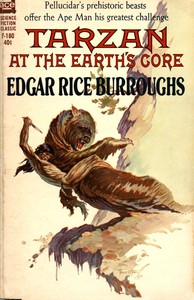
When word came from the inner world that David Innes, Emperor of Pellucidar, was imprisoned in a Korsar dungeon, Jason Gridley sped to the jungles of Africa to seek aid from the one man capable of besting the terrors of savage Pellucidar. And Tarzan, true to his reputation, organized an expedition, supervised construction of a giant dirigible, and set off at once for the polar entrance to the hidden land.
But having arrived, Tarzan realized the worst was yet before them. For almost immediately, Tarzan, Jason, Captain Zuppner and the ten Waziri warriors became separated--each forced to face the terrors of the unknown alone.
The thrills of man against prehistoric monster are at fever pitch in TARZAN AT THE EARTH'S CORE.
FOREWORD
Pellucidar, as every schoolboy knows, is a world within a world, lying, as it does, upon the inner surface of the hollow sphere, which is the Earth.
It was discovered by David Innes and Abner Perry upon the occasion when they made the trial trip upon the mechanical prospector invented by Perry, wherewith they hoped to locate new beds of anthracite coal. Owing, however, to their inability to deflect the nose of the prospector, after it had started downward into the Earth's crust, they bored straight through for five hundred miles, and upon the third day, when Perry was already unconscious owing to the consumption of their stock of oxygen, and David was fast losing consciousness, the nose of the prospector broke through the crust of the inner world and the cabin was filled with fresh air.
In the years that have intervened, weird adventures have befallen these two explorers. Perry has never returned to the outer crust, and Innes but once--upon that occasion when he made the difficult and dangerous return trip in the prospector for the purpose of bringing back to the empire he had founded in the inner world the means to bestow upon his primitive people of the stone age the civilization of the twentieth century.
But what with battles with primitive men and still more primitive beasts and reptiles, the advance of the empire of Pellucidar toward civilization has been small; and in so far as the great area of the inner world is concerned, or the countless millions of its teeming life of another age than ours, David Innes and Abner Perry might never have existed.
When one considers that these land and water areas upon the surface of Pellucidar are in opposite relationship to the same areas upon the outer crust, some slight conception of the vast extent of this mighty world within a world may be dreamed.
The land area of the outer world comprises some fifty-three million square miles, or one-quarter of the total area of the earth's surface; while within Pellucidar three-quarters of the surface is land, so that jungle, mountain, forest and plain stretch interminably over 124,110,000 square miles; nor are the oceans with their area of 41,370,000 square miles of any mean or niggardly extent.
Thus, considering the land area only, we have the strange anomaly of a larger world within a smaller one, but then Pellucidar is a world of deviation from what we of the outer crust have come to accept as unalterable laws of nature.
In the exact center of the earth hangs Pellucidar's sun, a tiny orb compared with ours, but sufficient to illuminate Pellucidar and flood her teeming jungles with warmth and life-giving rays. Her sun hanging thus perpetually at zenith, there is no night upon Pellucidar, but always an endless eternity of noon.
There being no stars and no apparent movement of the sun, Pellucidar has no points of compass; nor has she any horizon since her surface curves always upward in all directions from the observer, so that far above one's line of vision, plain or sea or distant mountain range go onward and upward until lost in the haze of the distance. And again, in a world where there is no sun, no stars and no moon, such as we know, there can be no such thing as time, as we know it. And so, in Pellucidar, we have a timeless world which must necessarily be free from those pests who are constantly calling our attention to "the busy little bee" and to the fact that "time is money." While time may be "the soul of this world" and the "essence of contracts," in the beatific existence of Pellucidar it is nothing and less than nothing.
Keep going from exactly here — Folio remembers your place and serves the next portion tomorrow.
continue reading Tarzan at the Earth's CoreAbout this free edition
Tarzan at the Earth's Core by Edgar Rice Burroughs (1875-1950) is free to read in full. Folio serves it in daily portions you can actually finish, tracks your streak and reading position across devices, and reads every page aloud with a built-in narrator. The text comes from Project Gutenberg.
More like Tarzan at the Earth's Core
The Oakdale Affair
Folio
The Oakdale Affair
Edgar Rice Burroughs

Tarzan of the Apes
Edgar Rice Burroughs
Tarzan the Terrible
Folio
Tarzan the Terrible
Edgar Rice Burroughs

Jungle Tales of Tarzan
Edgar Rice Burroughs
The Mucker
Folio
The Mucker
Edgar Rice Burroughs
The Monster Men
Folio
The Monster Men
Edgar Rice Burroughs
The Return of Tarzan
Edgar Rice Burroughs
Tarzan and the Jewels of Opar
Edgar Rice Burroughs