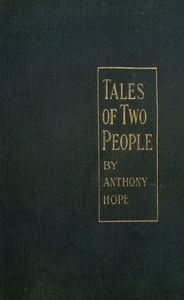
Tales of Two People
free to read
length
99,572 words
a few pages a day
~8 min
finished in
53 days
full read
6h 55m
At Folio's default of ten pages a day, you finish Tales of Two People in about 53 days — roughly 8 minutes of reading each morning.
The opening
the first pages of Tales of Two People, free
Common opinion said that Lord Lynborough ought never to have had a peerage and forty thousand a year; he ought to have had a pound a week and a back bedroom in Bloomsbury. Then he would have become an eminent man; as it was, he turned out only a singularly erratic individual.
So much for common opinion. Let no more be heard of its dull utilitarian judgments! There are plenty of eminent men--at the moment, it is believed, no less than seventy Cabinet and ex-Cabinet Ministers (or thereabouts)--to say nothing of Bishops, Judges, and the British Academy--and all this in a nook of the world! (And the world too is a point!) Lynborough was something much more uncommon; it is not, however, quite easy to say what. Let the question be postponed; perhaps the story itself will answer it.
He started life--or was started in it--in a series of surroundings of unimpeachable orthodoxy--Eton, Christ Church, the Grenadier Guards. He left each of these schools of mental culture and bodily discipline, not under a cloud--that metaphor would be ludicrously inept--but in an explosion. That, having been thus shot out of the first, he managed to enter the second--that, having been shot out of the second, he walked placidly into the third--that, having been shot out of the third, he suffered no apparent damage from his repeated propulsions--these are matters explicable only by a secret knowledge of British institutions. His father was strong, his mother came of stock even stronger; he himself--Ambrose Caverly as he then was--was very popular, and extraordinarily handsome in his unusual outlandish style.
His father being still alive--and, though devoted to him, by now apprehensive of his doings--his means were for the next few years limited. Yet he contrived to employ himself. He took a soup-kitchen and ran it; he took a yacht and sank it; he took a public-house, ruined it, and got himself severely fined for watering the beer in the Temperance interest. This injustice rankled in him deeply, and seems to have permanently influenced his development. For a time he forsook the world and joined a sect of persons who called themselves “Theophilanthropists”--and surely no man could call himself much more than that? Returning to mundane affairs, he refused to pay his rates, stood for Parliament in the Socialist interest, and, being defeated, declared himself a practical follower of Count Tolstoy. His father advising a short holiday, he went off and narrowly escaped being shot somewhere in the Balkans, owing to his having taken too keen an interest in local politics. (He ought to have been shot; he was clear--and even vehement--on that point in a letter which he wrote to The Times.) Then he sent for Leonard Stabb, disappeared in company with that gentleman, and was no more seen for some years.
He could always send for Stabb, so faithful was that learned student’s affection for him. A few years Ambrose Caverly’s senior, Stabb had emerged late and painfully from a humble origin and a local grammar school, had gone up to Oxford as a non-collegiate man, had gained a first-class and a fellowship, and had settled down to a life of research. Early in his career he became known by the sobriquet of “Cromlech Stabb”--even his unlearned friends would call him “Cromlech” oftener than by any other name. His elaborate monograph on cromlechs had earned him the title; subsequently he extended his researches to other relics of ancient religions--or ancient forms of religion, as he always preferred to put it; “there being,” he would add, with the simplicity of erudition beaming through his spectacles on any auditor, orthodox or other, “of course, only one religion.” He was a very large stout man; his spectacles were large too. He was very strong, but by no means mobile. Ambrose’s father regarded Stabb’s companionship as a certain safeguard to his heir. The validity of this idea is doubtful. Students have so much curiosity--and so many diverse scenes and various types of humanity can minister to that appetite of the mind.
Keep going from exactly here — Folio remembers your place and serves the next portion tomorrow.
continue reading Tales of Two PeopleAbout this free edition
Tales of Two People by Anthony Hope (1863-1933) is free to read in full. Folio serves it in daily portions you can actually finish, tracks your streak and reading position across devices, and reads every page aloud with a built-in narrator. The text comes from Project Gutenberg.
More like Tales of Two People
The Secret of the Tower
Folio
The Secret of the Tower
Anthony Hope

The Prisoner of Zenda
Anthony Hope
Rupert of Hentzau
Folio
Rupert of Hentzau
Anthony Hope
The Chronicles of Count Antonio
Anthony Hope
Phroso
Anthony Hope
The Heart of Princess Osra
Folio
The Heart of Princess Osra
Anthony Hope
Frivolous Cupid
Folio
Frivolous Cupid
Anthony Hope
A Man of Mark
Folio
A Man of Mark
Anthony Hope