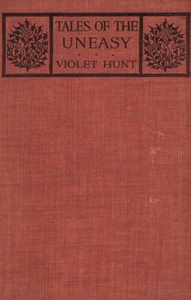
Tales of the Uneasy
first published 1911 · free to read
length
88,996 words
a few pages a day
~8 min
finished in
47 days
full read
6h 11m
At Folio's default of ten pages a day, you finish Tales of the Uneasy in about 47 days — roughly 8 minutes of reading each morning.
The opening
the first pages of Tales of the Uneasy, free
She would be no poorer, it was not that. She was an orphan, and all her mother had had came to her. That meant seventy thousand pounds, plate, linen and the freehold of a fine old house in Lower Seymour Street, that they had moved into a year before the old lady died.
Things were no more altered socially than they were altered pecuniarily, for the Damers’ set naturally corresponded, as sets do, with their postal district, and Miss Alice Damer could therefore continue to command an entrance into the best circles. Only she realized that she must henceforth enjoy all these good things to the tune of a paid companion, having no poor and amenable relations handy whom she could draft into the household economy, and afterwards snub into a colourless, bare existence.
She was thirty-five, and her years did not weigh on her, except mentally. The first faint physical signs of the debacle were, so far, evident to herself alone, and then only in moods of unusual depression. She was still young enough to need a companion. Her pretty red-gold hair was as red as gold, as pretty as ever, her visits to her dentist as few, her eyes as deep, and her step as elastic, although she had given up dancing. She had made this sacrifice more from a sense of fitness, as a concession to the needs of the young girls coming up all round her, and who deserved their turn on the floor, than of social necessity. As a matter of fact, she had never been really fond of that over-energetic, disordering form of amusement. She loved the world and going up and down in it immensely, and her way of enjoying parties was to sit out if it was a dance, away from the music if it was a concert, and in the back of the box if it was a play. She was a flirt.
Not an outrageous, noisy, ill-bred flirt, but what is known as a quiet flirt, with many strong and efficient strings to her bow. Did one of them, being after all only catgut or mere man, snap occasionally--that is to say, get married out of the circle of her charm--Alice, in her quiet way, promptly renewed the string, and supplied herself with a new admirer, as good at fetching and carrying as the old. In her mind that was the chief use of admirers--to prevent one’s looking neglected--of course one never really was!
She was a woman of many “affairs”; she liked living, not exactly in hot water, but in water at least warm, and was seldom seen talking to women, though she was quite nice to them, as intrusive but law-permitted aliens in the pays du cœur. None of her friends would have dared to ask her to a ladies’ lunch, or any over-womaned party; a man had always to be “got for Alice,” else she would have been hurt, and quite unable to play her part properly. She was unused to, unversed in her own sex.
On the other hand, she played fair and never took other women’s men, or encouraged their husbands to play the pretty game with her. People said that for her, that she never made women unhappy, only men. She was never very sorry for a man’s love-troubles, for she had a theory that a hopeless passion or two did a man no harm and that the more he proposed the merrier--for him. She never told any one how many offers she had refused. Men often did propose to her, and she refused them all, and boasted that she had never been engaged for even an hour, and that no man had ever kissed her. The bloom was not off Alice, unless so much mental coming and going in her courts had produced some such subtle effect.
“Why should I marry?” she used to say to Everard Jenkyns (good old Welsh family), when he importuned her to relax her rule in his favour, and even go so far as making the vast experiment of marriage with him as her partner. “There is no earthly hurry.”
“No, but perhaps a heavenly one,” he had inanely replied.
“I may never marry at all. Girls, economically, don’t need to marry as they used to, and at any rate I am independent so far as money goes.”
Keep going from exactly here — Folio remembers your place and serves the next portion tomorrow.
continue reading Tales of the UneasyAbout this free edition
Tales of the Uneasy by Violet Hunt (1862-1942) is free to read in full. Folio serves it in daily portions you can actually finish, tracks your streak and reading position across devices, and reads every page aloud with a built-in narrator. The text comes from Project Gutenberg.
More like Tales of the Uneasy
Dracula
Bram Stoker
The Strange Case of Dr. Jekyll and Mr. Hyde
Robert Louis Stevenson
The Turn of the Screw
Folio
The Turn of the Screw
Henry James
The Picture of Dorian Gray
Oscar Wilde
The Fall of the House of Usher
Folio
The Fall of the House of Usher
Edgar Allan Poe
Carmilla
Joseph Sheridan Le Fanu
Uncle Silas
Folio
Uncle Silas
Joseph Sheridan Le Fanu
The Castle of Otranto
Folio
The Castle of Otranto
Horace Walpole