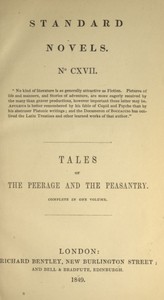
length
159,523 words
a few pages a day
~8 min
finished in
84 days
full read
11h 5m
At Folio's default of ten pages a day, you finish Tales of the peerage and the peasantry in about 84 days — roughly 8 minutes of reading each morning.
The opening
the first pages of Tales of the peerage and the peasantry, free
The authoress feels much diffidence in sending forth to the world a tale which by its title gives promise of treating not only of history, but of Scottish history; an act of presumption from which she is anxious to clear herself;--and at the same time she wishes to re-assure those readers who may not like historical novels from a woman's pen, that she has entered no farther into public affairs, than as they may have influenced the fortunes and feelings of the one admirable woman who forms the subject of the following memoir.
Since in the human heart the same passions and the same emotions are found in all ages, she hopes she has not trespassed beyond the limits assigned to one who is conscious that all she writes bears the stamp of feminine authorship, in attempting the development of a female character, the firmness and tenderness of which may be gathered from Lady Nithsdale's own beautiful letter to her sister.
The foundation of the story of the Hampshire Cottage is strictly true. The appearance, the characters, the sentiments, and the death of the old couple, are entirely from nature. Their very Christian names have been preserved; and the circumstance of the blind old man feeling too low for the head of the little girl, who had outgrown his recollection, actually occurred to the authoress, when visiting the cottage after a long absence.
For reasons which perhaps may be understood by her friends, she adds, that the tale of Blanche was written in the year 1832.
London. June 26, 1835.
CONTENTS.
Page
Winifred, Countess of Nithsdale 1 The Hampshire Cottage 194 Blanche 273
TALES
OF
THE PEERAGE AND THE PEASANTRY.
WINIFRED, COUNTESS OF NITHSDALE.
CHAPTER I.
My father stood for his true king, Till standing it could do nae mair; The day is lost, and so are we,-- Nae wonder mony a heart is sair.
Jacobite Song.
The sound of the organ pealed through the chapel of the English Augustine convent at Bruges: a bright gleam of sunshine, streaming through the painted window to the south of the altar, shone upon the clouds of incense which arose in silvery folds from the censers; it shone upon the white-robed assistants, upon the priests, and upon the calm brow of the young nun who had that moment taken the irrevocable vows which separated her from the world--a world of which she knew but little; but which, from the circumstances in which her family was placed, offered not to her the temptations it usually holds out to youth, beauty, and rank such as hers.
The Lady Lucy Herbert was the fourth daughter of William Marquis of Powis, who, having devoted himself to the cause of James the Second, and accompanied his queen in her flight to France, received from the exiled monarch, as a reward for his uncompromising loyalty, the empty titles of Marquis of Montgomery and Duke of Powis.
James afterwards appointed him steward and chamberlain to his household--offices which, although of small advantage, may have been gratifying to his feelings, as proofs of the estimation in which he was held by the master to whom he had sacrificed everything.
Upon the Duke of Powis's death, which took place in 1696, his widow placed her two youngest daughters in the English Augustine convent at Bruges; while the three elder remained with her at the melancholy shadow of a court still kept up at St. Germain's.
It was no grief to the widowed mother when she found that the bent of the young Lucy's mind was sincerely and enthusiastically directed towards a religious life. Although the attainder had been reversed, and her son had been restored to the Marquisate of Powis, it was not till some years afterwards that she had ventured to return to England; even then she lived in retirement and privacy. The widow of so zealous an adherent to King James could not be regarded without suspicion; her means were scanty; her elder daughters had not then made the advantageous alliances which they afterwards formed; and joyfully did she hail the vocation which she hoped would secure, to one of her children at least, a peaceful and tranquil existence, secure from any farther vicissitudes of fortune.
Keep going from exactly here — Folio remembers your place and serves the next portion tomorrow.
continue reading Tales of the peerage and the peasantryAbout this free edition
Tales of the peerage and the peasantry by Arabella Jane Sullivan (1797?-1839) is free to read in full. Folio serves it in daily portions you can actually finish, tracks your streak and reading position across devices, and reads every page aloud with a built-in narrator. The text comes from Project Gutenberg.
More like Tales of the peerage and the peasantry
Recollections of a chaperon
Arabella Jane Sullivan
Pride and Prejudice
Jane Austen
Sense and Sensibility
Jane Austen
Emma
Folio
Emma
Jane Austen
Persuasion
Folio
Persuasion
Jane Austen
Mansfield Park
Folio
Mansfield Park
Jane Austen
Jane Eyre
Charlotte Brontë
The Tenant of Wildfell Hall
Folio
The Tenant of Wildfell Hall
Anne Brontë