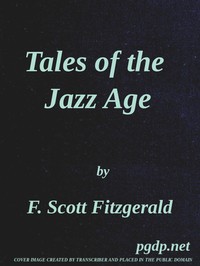
length
86,601 words
a few pages a day
~8 min
finished in
46 days
full read
6h 1m
At Folio's default of ten pages a day, you finish Tales of the Jazz Age in about 46 days — roughly 8 minutes of reading each morning.
The opening
the first pages of Tales of the Jazz Age, free
_This is a Southern story, with the scene laid in the small city of Tarleton, Georgia. I have a profound affection for Tarleton, but somehow whenever I write a story about it I receive letters from all over the South denouncing me in no uncertain terms. “The Jelly-Bean,” published in “The Metropolitan,” drew its full share of these admonitory notes._
_It was written under strange circumstances shortly after my first novel was published, and, moreover, it was the first story in which I had a collaborator. For, finding that I was unable to manage the crap-shooting episode, I turned it over to my wife, who, as a Southern girl, was presumably an expert on the technique and terminology of that great sectional pastime._
THE CAMEL’S BACK
_I suppose that of all the stories I have ever written this one cost me the least travail and perhaps gave me the most amusement. As to the labor involved, it was written during one day in the city of New Orleans, with the express purpose of buying a platinum and diamond wrist watch which cost six hundred dollars. I began it at seven in the morning and finished it at two o’clock the same night. It was published in the “Saturday Evening Post” in 1920, and later included in the O. Henry Memorial Collection for the same year. I like it least of all the stories in this volume._
_My amusement was derived from the fact that the camel part of the story is literally true; in fact, I have a standing engagement with the gentleman involved to attend the next fancy-dress party to which we are mutually invited, attired as the latter part of the camel--this as a sort of atonement for being his historian._
MAY DAY
_This somewhat unpleasant tale, published as a novelette in the “Smart Set” in July, 1920, relates a series of events which took place in the spring of the previous year. Each of the three events made a great impression upon me. In life they were unrelated, except by the general hysteria of that spring which inaugurated the Age of Jazz, but in my story I have tried, unsuccessfully I fear, to weave them into a pattern--a pattern which would give the effect of those months in New York as they appeared to at least one member of what was then the younger generation._
PORCELAIN AND PINK
“And do you write for any other magazines?” inquired the young lady.
“Oh, yes,” I assured her. “I’ve had some stories and plays in the ‘Smart Set,’ for instance----”
The young lady shivered.
“The ‘Smart Set’!” she exclaimed. “How can you? Why, they publish stuff about girls in blue bathtubs, and silly things like that.”
And I had the magnificent joy of telling her that she was referring to “Porcelain and Pink,” which had appeared there several months before.
FANTASIES
THE DIAMOND AS BIG AS THE RITZ
_These next stories are written in what, were I of imposing stature, I should call my “second manner.” “The Diamond as Big as the Ritz,” which appeared last summer in the “Smart Set,” was designed utterly for my own amusement. I was in that familiar mood characterized by a perfect craving for luxury, and the story began as an attempt to feed that craving on imaginary foods._
_One well-known critic has been pleased to like this extravaganza better than anything I have written. Personally I prefer “The Offshore Pirate.” But, to tamper slightly with Lincoln: If you like this sort of thing, this, possibly, is the sort of thing you’ll like._
THE CURIOUS CASE OF BENJAMIN BUTTON
_This story was inspired by a remark of Mark Twain’s to the effect that it was a pity that the best part of life came at the beginning and the worst part at the end. By trying the experiment upon only one man in a perfectly normal world I have scarcely given his idea a fair trial. Several weeks after completing it, I discovered an almost identical plot in Samuel Butler’s “Note-books.”_
Keep going from exactly here — Folio remembers your place and serves the next portion tomorrow.
continue reading Tales of the Jazz AgeAbout this free edition
Tales of the Jazz Age by F. Scott Fitzgerald (1896-1940) is free to read in full. Folio serves it in daily portions you can actually finish, tracks your streak and reading position across devices, and reads every page aloud with a built-in narrator. The text comes from Project Gutenberg.
More like Tales of the Jazz Age
The Great Gatsby
F. Scott Fitzgerald
This Side of Paradise
F. Scott Fitzgerald
The Beautiful and Damned
F. Scott Fitzgerald
Pride and Prejudice
Jane Austen
Sense and Sensibility
Jane Austen
Emma
Folio
Emma
Jane Austen
Persuasion
Folio
Persuasion
Jane Austen
Mansfield Park
Folio
Mansfield Park
Jane Austen