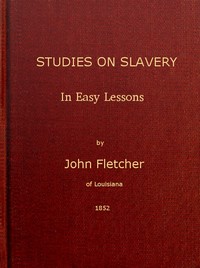
Studies on Slavery, in Easy Lessons
free to read
length
255,411 words
a few pages a day
~8 min
finished in
135 days
full read
17h 44m
At Folio's default of ten pages a day, you finish Studies on Slavery, in Easy Lessons in about 135 days — roughly 8 minutes of reading each morning.
The opening
the first pages of Studies on Slavery, in Easy Lessons, free
Minor errors in punctuation and formatting have been silently corrected. Please see the transcriber’s note at the end of this text for details regarding the handling of any textual issues encountered during its preparation.
Please consult the end notes, as well, for the approach used in the rendering of Arabic, Greek, Coptic, Hebrew and Syriac text.
This version of the text cannot represent certain typographical effects. Italics are delimited with the ‘’ character as italic. Bold font is delimited by the ‘=’ character. Superscripted and subscripted characters are shown as ‘^2’ and ‘{2}’ respectively. The rendering of certain characters in classical languages may not display correctly in your reader. Alignment in tables may also be compromised.
STUDIES ON SLAVERY, In Easy Lessons.
COMPILED INTO EIGHT STUDIES, AND SUBDIVIDED INTO SHORT LESSONS FOR THE CONVENIENCE OF READERS.
BY JOHN FLETCHER,
OF LOUISIANA.
--------------
FIFTH THOUSAND.
NATCHEZ: PUBLISHED BY JACKSON WARNER.
CHARLESTON: McCARTER & ALLEN.—NEW ORLEANS: JOHN BALL. PHILADELPHIA: THOMAS, COWPERTHWAIT & CO. 1852.
-----------------------
ENTERED according to Act of Congress, in the year 1851, by JACKSON WARNER, sin the Clerk’s Office of the District Court of the Southern District of Mississippi.
PRINTED BY SMITH & PETERS, Franklin Buildings, Sixth Street below Arch, Philadelphia.
--------------
PUBLISHER’S PREFACE.
This is a legitimate topic of general interest, and it assumes a preponderating importance to the people of the Southern American States, when the fact is taken into consideration that a general league against the institution of African slavery has been entered into and consummated between most of the civilized nations of the earth, and public opinion in many of the sister States of our own National Union has taken the same direction. The result is, to have arraigned the slaveholding States before the mighty bar of public opinion, on the charge of holding, as property, more than ten hundred millions of dollars’ worth of what does not belong to them, which is and never can be the property of man; and this charge embraces, within its scope, the crimes of theft, robbery, rapine, and cruelty.
The time has come when the South must enter her plea of defence, not because the accusers are foreign nations, of which it may justly be said, before their charges are entertained, “Physician, heal thyself,” but because our accusers are among our own brethren, bound to us by freedom’s holiest associations and religion’s most sacred ties.
The author of the “Studies on Slavery” has the double advantage of a full comprehension of the subject both in its Northern and Southern aspect. Born and educated in the former, and qualified by a long residence in the latter section of our Union, he is amply qualified to weigh the prejudices, the teachings, and the arguments of the one, against the facts, the justifications, the religious and political sanctions of the other.
Mr. Fletcher has not only marshalled into his line of impregnable defence the mandates and sanctions of the Sacred Writings concerning the slave institutions, but he has drawn powerful auxiliaries from the sources of ancient history. His exegesis of biblical passages, in the original languages in which they were communicated by inspiration to the world, shows his sound scholarship, as well as his reverence of the literal sense and specific meaning of God’s holy and unimpeachable standard and rule of life and action.
Keep going from exactly here — Folio remembers your place and serves the next portion tomorrow.
continue reading Studies on Slavery, in Easy LessonsAbout this free edition
Studies on Slavery, in Easy Lessons by John Fletcher (1791-1862) is free to read in full. Folio serves it in daily portions you can actually finish, tracks your streak and reading position across devices, and reads every page aloud with a built-in narrator. The text comes from Project Gutenberg.
More like Studies on Slavery, in Easy Lessons
Meditations
Folio
Meditations
Marcus Aurelius
The Enchiridion
Epictetus

Thus Spake Zarathustra
Friedrich Nietzsche
Beyond Good and Evil
Folio
Beyond Good and Evil
Friedrich Nietzsche
The Genealogy of Morals
Folio
The Genealogy of Morals
Friedrich Nietzsche
The Republic
Folio
The Republic
Plato
Apology
Folio
Apology
Plato
Crito
Folio
Crito
Plato