length
30,311 words
a few pages a day
~8 min
finished in
16 days
full read
2h 6m
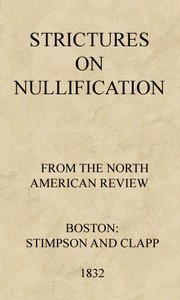
At Folio's default of ten pages a day, you finish Strictures on Nullification in about 16 days — roughly 8 minutes of reading each morning.
The opening
the first pages of Strictures on Nullification, free
The discontents on the subject of the Tariff, which have so long existed in several of the Southern States, and particularly in South Carolina, have at length reached a crisis. As soon as it was ascertained that the party in favor of Nullification had prevailed in that State at the late elections, the Governor immediately summoned an extraordinary session of the Legislature, which was held accordingly at Columbia, on the 22d of October. In calling together the new Legislature before the end of the current political year, as generally understood, the Governor exercised an authority, which may perhaps be fairly considered as doubtful, although it appears to have been sanctioned by the highest judicial authority of the State. This, however, is a secondary question, upon which we shall not enlarge. In the message which he transmitted to the Legislature at the opening of the extraordinary session, the Governor recommended to them to pass an act authorizing the meeting of a Convention, to deliberate upon the measures to be taken by the State for the purpose of obtaining relief from the operation of the Tariff. The act was accordingly passed by large majorities,--two thirds being required by the Constitution;--and the Convention, which was chosen in pursuance of it, opened its session at Columbia on the 19th of November.
This body proceeded at once and without much discussion to adopt what they call an 'Ordinance to nullify' the Revenue laws of the country, which we propose to copy in the course of our remarks. Having published this act, with an accompanying exposition of their motives in passing it, and addresses to the people of the United States and of South Carolina, the Convention adjourned without delay, leaving it in charge to a committee appointed for that purpose to summon another meeting, if it should appear expedient. The composition of the Ordinance is attributed to Chancellor Harper; that of the exposition accompanying it to Mr. McDuffie; and that of the addresses to the people of the United States and of South Carolina respectively to General Hayne and Mr. Turnbull. The Legislature of the State have since assembled, and, agreeably to the tenor of the Ordinance, will doubtless pass such laws as may be thought necessary for carrying the measure into full effect.
These proceedings constitute a very serious crisis,--the most serious that has occurred in the history of our country since the establishment of the Government, with the exception of that which attended the close of the last war with Great Britain, and from which, by the fortunate intervention of the Peace, we escaped without injury. In the present instance, there seems to be no prospect of evading the difficulty in any such way. We must meet it in front, and either overcome it, or submit to all its consequences.
The general principles by which the statesmen of South Carolina undertake to support their views, have been already very fully discussed in various quarters. But, considering the great importance and urgent interest of the subject, it may not be wholly superfluous to take, once more, a calm, and as far as may be, impartial survey of the ground in dispute. In doing this, we shall of course leave out of view the topics of the constitutionality and expediency of the measures of the General Government, which are the motive or pretext for the present proceedings in Carolina. Believing, as we do, that the Protecting Policy is founded in a correct understanding of the principles of the Constitution, and of the true interest of the country, we still very cheerfully recognise in our fellow-citizens of all the States, the right to entertain a different opinion, and to act upon it in a legal and constitutional way. The precise question now before us is, whether the present proceedings in South Carolina are legal and constitutional. The most authentic and elaborate exposition of the arguments that are urged in defence of them, is to be found in the letter of the Vice-President of the United States to Governor Hamilton, of August 28, 1832, to which we shall accordingly refer as the leading authority in their favor.
Keep going from exactly here — Folio remembers your place and serves the next portion tomorrow.
continue reading Strictures on NullificationAbout this free edition
Strictures on Nullification by Alexander Hill Everett (1790-1847) is free to read in full. Folio serves it in daily portions you can actually finish, tracks your streak and reading position across devices, and reads every page aloud with a built-in narrator. The text comes from Project Gutenberg.
More like Strictures on Nullification
The History of the Peloponnesian War
Folio
The History of the Peloponnesian War
Thucydides
The History of Herodotus
Folio
The History of Herodotus
Herodotus
The Gallic Wars
Folio
The Gallic Wars
Julius Caesar
Anabasis
Folio
Anabasis
Xenophon
The Lives of the Twelve Caesars
Folio
The Lives of the Twelve Caesars
Suetonius
Germania
Folio
Germania
Tacitus
The History of the Decline and Fall of the Roman Empire
Edward Gibbon
The Travels of Marco Polo
Marco Polo