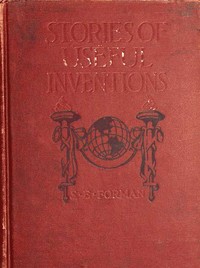
Stories of Useful Inventions
free to read
length
45,509 words
a few pages a day
~8 min
finished in
24 days
full read
3h 10m
At Folio's default of ten pages a day, you finish Stories of Useful Inventions in about 24 days — roughly 8 minutes of reading each morning.
The opening
the first pages of Stories of Useful Inventions, free
In this little book I have given the history of those inventions which are most useful to man in his daily life. I have told the story of the Match, the Stove, the Lamp, the Forge, the Steam-Engine, the Plow, the Reaper, the Mill, the Loom, the House, the Carriage, the Boat, the Clock, the Book, and the Message. From the history of these inventions we learn how man became the master of the world of nature around him, how he brought fire and air and earth and water under his control and compelled them to do his will and his work. When we trace the growth of these inventions we at the same time trace the course of human progress. These stories, therefore, are stories of human progress; they are chapters in the history of civilization.
And they are chapters which have not hitherto been brought together in one book. Monographs on most of the subjects included in this book have appeared, and excellent books about modern inventions have been written, but as far as I know, this is the first time the evolution of these useful inventions has been fully traced in a single volume.
While preparing the stories I have received many courtesies from officers in the Library of Congress and from those of the National Museum.
S. E. F.
May, 1911. Washington, D. C.
CONTENTS
PAGE
THE FOREWORD ix
I THE MATCH 3
II THE STOVE 13
III THE LAMP 28
IV THE FORGE 38
V THE STEAM-ENGINE 54
VI THE PLOW 73
VII THE REAPER 85
VIII THE MILL 97
IX THE LOOM 109
X THE HOUSE 123
XI THE CARRIAGE 144
XII THE CARRIAGE (Continued) 156
XIII THE BOAT 166
XIV THE CLOCK 187
XV THE BOOK 203
XVI THE MESSAGE 222
A FOREWORD[1]
These stories of useful inventions are chapters in the history of civilization and this little book is a book of history. Now we are told by Herodotus, one of the oldest and greatest of historians, that when the writer of history records an event he should state the time and the place of its happening. In some kinds of history--in the history of the world's wars, for example, or in the history of its politics--this is strictly true. When we are reading of the battle of Bunker Hill we should be told precisely when and where the battle was fought, and in an account of the Declaration of Independence the time and place of the declaration should be given. But in the history of inventions we cannot always be precise as to dates and places. Of course it cannot be told when the first plow or the first loom or the first clock was made. Inventions like these had their origin far back in the earliest ages when there was no such person as a historian. And when we come to the history of inventions in more recent times the historian is still sometimes unable to discover the precise time and place of an invention.
It is in the nature of things that the origin of an invention should be surrounded by uncertainty and doubt. An invention, as we shall see presently, is nearly always a response to a certain want. The world wants something and it promises a rich reward to one who will furnish the desired thing. The inventor, recognizing the want, sets to work to make the thing, but he conducts his experiments in secret, for the reason that he does not want another to steal his ideas and get ahead of him. We can see that this is true in respect to the flying machine. The first experiments with the flying machine were conducted in secret in out of the way places and pains were taken that the public should know as little as possible about the new machine and about the results of the experiments. The history of the flying machine will of course have to be written, but because of the secrecy and mystery which surrounded the beginnings of the invention it will be extremely difficult for the future historian to tell precisely when the first flying machine was invented or to name the inventor. If it is so difficult to get the facts as to the origin of an invention in our own time, how much more difficult it is to clear away the mystery and doubt which surround the beginnings of an invention in an age long past!
Keep going from exactly here — Folio remembers your place and serves the next portion tomorrow.
continue reading Stories of Useful InventionsAbout this free edition
Stories of Useful Inventions by S. E. Forman (1858-1941) is free to read in full. Folio serves it in daily portions you can actually finish, tracks your streak and reading position across devices, and reads every page aloud with a built-in narrator. The text comes from Project Gutenberg.
More like Stories of Useful Inventions
The History of the Peloponnesian War
Folio
The History of the Peloponnesian War
Thucydides
The History of Herodotus
Folio
The History of Herodotus
Herodotus
The Gallic Wars
Folio
The Gallic Wars
Julius Caesar
Anabasis
Folio
Anabasis
Xenophon
The Lives of the Twelve Caesars
Folio
The Lives of the Twelve Caesars
Suetonius
Germania
Folio
Germania
Tacitus
The History of the Decline and Fall of the Roman Empire
Edward Gibbon
The Travels of Marco Polo
Marco Polo