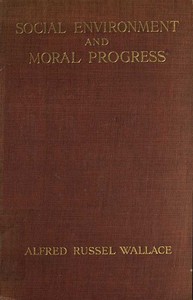
Social Environment and Moral Progress
by Alfred Russel Wallace (1823-1913)
first published 1913 · free to read
length
30,378 words
a few pages a day
~8 min
finished in
16 days
full read
2h 7m
At Folio's default of ten pages a day, you finish Social Environment and Moral Progress in about 16 days — roughly 8 minutes of reading each morning.
The opening
the first pages of Social Environment and Moral Progress, free
Before entering on the question of the relation of morality to our existing social environment, it will be advisable to inquire what we mean by moral progress, and what evidence there is that any such progress has occurred in recent times, or even within the period of well-established history.
By morals we mean right conduct, not only in our immediate social relations, but also in our dealings with our fellow citizens and with the whole human race. It is based upon the possession of clear ideals as to what actions are right and what are wrong and the determination of our conduct by a constant reference to those ideals.
The belief was once prevalent, and is still held by many persons, that a knowledge of right and wrong is inherent or instinctive in everyone, and that the immoral person may be justly punished for such wrongdoing as he commits. But that this cannot be wholly, if at all, true is shown by the fact that in different societies and at different periods the standard of right and wrong changes considerably. That which at one time and place is held to be right and proper is, at another time or place, considered to be not only wrong, but one of the greatest of crimes. The most striking example of this change of opinion is that as to slavery, which was held to be quite justifiable by the most highly civilised people of antiquity, and hardly less so by ourselves within the memory of persons still living. The owners of sugar estates in Jamaica cultivated by slaves were not stigmatised as immoral by their relatives in England or by the public at large; and it was the horror excited by the slave-trade in Africa, and in the "middle passage" on the slave ships, rather than by the slavery itself, that so excited public opinion as to lead to the abolition first of the one and then of the other.
We are obliged to conclude, therefore, that what is commonly termed morality is not wholly due to any inherent perception of what is right or wrong conduct, but that it is to some extent and often very largely a matter of convention, varying at different times and places in accordance with the degree and kind of social development which has been attained often under different and even divergent conditions of existence. The actual morality of a community is largely a product of the environment, but it is local and temporary, not permanently affecting the character.
To bring together the evidence in support of this view, to distinguish between what is permanent and inherited and what is superficial and not inherited, and to trace out some of the consequences as regards what we term "morality" is the purpose of the present volume.
CHAPTER II
MORALITY AS BASED UPON CHARACTER
Though much of what we term morality has no absolute sanction in human nature, yet it is to some extent, and perhaps very largely, based upon it. It will be well, therefore, to consider briefly the nature and probable origin of what we term "character"—in individuals, in societies, and especially in those more ancient and more fundamental divisions of mankind which we term "races."
Character may be defined as the aggregate of mental faculties and emotions which constitute personal or national individuality. It is very strongly hereditary, yet it is probably subject to more inherent variation than is the form and structure of the body. The combinations of its constituent elements are so numerous as, in common language, to be termed infinite; and this gives to each person a very distinct individuality, as manifested in speech, in emotional expression, and in action.
The mental faculties which go to form the "character" of each man or woman are very numerous, a large proportion of them being such as are required for the preservation of the individual and of the race, while others are pre-eminently social or ethical. These latter, which impel us to truth, to justice, and to benevolence, when in due proportion to all the other mental faculties, go to form what we distinguish as a good or moral character, and will in most cases result in actions which meet with the general approval of that section of society in which we live; and this approval reacts upon the character so that it often appears to be better than it really is.
Keep going from exactly here — Folio remembers your place and serves the next portion tomorrow.
continue reading Social Environment and Moral ProgressAbout this free edition
Social Environment and Moral Progress by Alfred Russel Wallace (1823-1913) is free to read in full. Folio serves it in daily portions you can actually finish, tracks your streak and reading position across devices, and reads every page aloud with a built-in narrator. The text comes from Project Gutenberg.
More like Social Environment and Moral Progress
Alfred Russel Wallace: Letters and Reminiscences
Folio
Alfred Russel Wallace: Letters and Reminiscences
Alfred Russel Wallace
A defence of modern spiritualism
Alfred Russel Wallace
Meditations
Folio
Meditations
Marcus Aurelius

The Enchiridion
Epictetus

Thus Spake Zarathustra
Friedrich Nietzsche
Beyond Good and Evil
Folio
Beyond Good and Evil
Friedrich Nietzsche
The Genealogy of Morals
Folio
The Genealogy of Morals
Friedrich Nietzsche
The Republic
Folio
The Republic
Plato