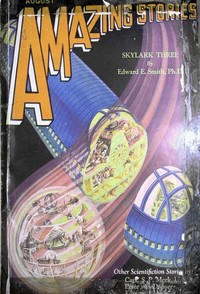
Skylark Three
first published 1930 · free to read
length
85,556 words
a few pages a day
~8 min
finished in
46 days
full read
5h 56m
At Folio's default of ten pages a day, you finish Skylark Three in about 46 days — roughly 8 minutes of reading each morning.
The opening
the first pages of Skylark Three, free
+--------------------------------------------------------------+ | For two years readers of AMAZING STORIES _have literally | | clamored for a sequel to the famous story, "The Skylark of | | Space," which appeared exactly two years ago. Except that | | "Skylark Three" is more thrilling, more exciting and even | | more chockful of science than the other. Dr. Smith tells | | about the story in his author's note far better than we can | | do._ | | | | Illustrated by WESSO | +--------------------------------------------------------------+
+--------------------------------------------------------------+ | Transcriber's Note | | | | This etext was produced from Amazing Stories August, | | September and October 1930. Extensive research did not | | uncover any evidence that the U.S. copyright on this | | publication was renewed. | | | | Other Transcriber Notes and Errata are given at the end of | | the text. | +--------------------------------------------------------------+
AUTHOR'S NOTE:
To all profound thinkers in the realms of Science who may chance to read SKYLARK THREE, greetings:
I have taken certain liberties with several more or less commonly accepted theories, but I assure you that those theories have not been violated altogether in ignorance. Some of them I myself believe sound, others I consider unsound, still others are out of my line, so that I am not well enough informed upon their basic mathematical foundations to have come to any definite conclusion, one way or the other. Whether or not I consider any theory sound, I did not hesitate to disregard it, if its literal application would have interfered with the logical development of the story. In "The Skylark of Space" Mrs. Garby and I decided, after some discussion, to allow two mathematical impossibilities to stand. One of these immediately became the target of critics from Maine to California and, while no astronomer has as yet called attention to the other, I would not be surprised to hear about it, even at this late date.
While I do not wish it understood that I regard any of the major features of this story as likely to become facts in the near future--indeed, it has been my aim to portray the highly improbable--it is my belief that there is no mathematical or scientific impossibility to be found in "Skylark Three."
In fact, even though I have repeatedly violated theories in which I myself believe, I have in every case taken great pains to make certain that the most rigid mathematical analysis of which I am capable has failed to show that I have violated any known and proven scientific fact. By "fact" I do not mean the kind of reasoning, based upon assumptions later shown to be fallacious, by which it was "proved" that the transatlantic cable and the airplane were scientifically impossible. I refer to definitely known phenomena which no possible future development can change--I refer to mathematical proofs whose fundamental equations and operations involve no assumptions and contain no second-degree uncertainties.
Please bear in mind that we KNOW very little. It has been widely believed that the velocity of light is the limiting velocity, and many of our leading authorities hold this view--but it cannot be proved, and is by no means universally held. In this connection, it would appear that J. J. Thompson, in "Beyond the Electron" shows, to his own satisfaction at least, that velocities vastly greater than that of light are not only possible, but necessary to any comprehensive investigation into the nature of the electron.
Keep going from exactly here — Folio remembers your place and serves the next portion tomorrow.
continue reading Skylark ThreeAbout this free edition
Skylark Three by E. E. Smith (1890-1965) is free to read in full. Folio serves it in daily portions you can actually finish, tracks your streak and reading position across devices, and reads every page aloud with a built-in narrator. The text comes from Project Gutenberg.
More like Skylark Three
The Skylark of Space
Folio
The Skylark of Space
E. E. Smith
Triplanetary
Folio
Triplanetary
E. E. Smith
Spacehounds of IPC
Folio
Spacehounds of IPC
E. E. Smith
Galactic Patrol
E. E. Smith
The Galaxy Primes
Folio
The Galaxy Primes
E. E. Smith
Subspace Survivors
Folio
Subspace Survivors
E. E. Smith
The Vortex Blaster
Folio
The Vortex Blaster
E. E. Smith
Masters of Space
Folio
Masters of Space
E. E. Smith