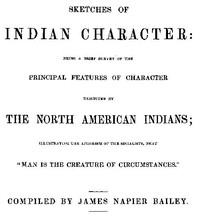
Sketches of Indian Character
free to read
length
38,748 words
a few pages a day
~8 min
finished in
21 days
full read
2h 41m
At Folio's default of ten pages a day, you finish Sketches of Indian Character in about 21 days — roughly 8 minutes of reading each morning.
The opening
the first pages of Sketches of Indian Character, free
“In order to complete the history of the human mind, and attain to a perfect knowledge of its nature and operations, we must contemplate man in all those various situations in which he has been placed. We must follow him in his progress through the different stages of society, as he gradually advances from the infant state of civil life towards its maturity and decline. We must observe at each period, how the faculties of his understanding unfold; we must attend to the efforts of his active powers, watch the various movements of desire and affection as they rise in his breast, and mark whither they tend, and with what ardour they are exerted.”
ROBERTSON.
Leeds: PRINTED AND PUBLISHED BY JOSHUA HOBSON, MARKET STREET, BRIGGATE; SOLD BY ABEL HEYWOOD, OLDHAM STREET, MANCHESTER; PATON AND LOVE, NELSON STREET, GLASGOW; JOHN CLEAVE, SHOE LANE, FLEET STREET, LONDON; AND ALL BOOKSELLERS.
1841.
SKETCHES OF INDIAN CHARACTER.
The history of nations fully establishes the fact, that the character of man results from the operation of circumstances on his organism. This great and important truth is written in such broad and legible characters on the face of human annals, as may easily be distinguished and can scarcely be mistaken. Among rude and savage tribes we discern features of character, which are distinctly referable to the influence of causes peculiar to the savage state; and among the members of civilized communities, we behold the manifestation of virtues, vices, and talents, which are also traceable to the operation of circumstances differing from those which determine the character of barbarous nations. There is a marked dissimilarity between the barbarian of Labrador and the native of London or Paris; yet this difference is more the child of accident than of nature, and would probably disappear in course of time were the parties to be subjected to the influence of similar institutions.
Among no people do we find more striking confirmations of the truth of the above doctrine than among the Aborigines of the North American Continent. In the character of that unhappy, but noble, race of men, we find many striking peculiarities which can be ascribed only to the influence of those circumstances in which the Indian tribes are placed, and which mark them out as objects of peculiar interest to the philosophic historian.
The European is polished, sagacious, and cunning; the Asiatic vainly proud and ostentatiously voluptuous; the African, patient, servile and debased; and the North American Indian, haughty, warlike and independent. Undoubtedly there are causes for all these varied peculiarities of national character, the developement of which, in relation to the Indians of America, shall form the subject of the present treatise.
In endeavouring to prove that man is the creature of circumstances by rapidly surveying the condition of the North American Indians, there are two methods which present themselves to our attention. The first and most obvious, consists in selecting the principal features of Indian character, and tracing them to the operation of causes peculiar to the Indian tribes. The second method consists in taking a view of the efforts made by white men for the civilization of the Americans, and the good or ill success which has attended their exertions. In discussing the subject, therefore, we shall adopt both these methods as far as our space and ability will allow.
The Indian character may be said to be a compound of the virtues and vices of savage life. Brave, generous, haughty and cruel, the North American savage moves with a firmness of step and a dignity of bearing, which distinguish him as the monarch of the wilderness. The African submits to slavery; the North American Indian prefers banishment, and even death to it. We pity and oppress the former, because his patient endurance of labour renders him of importance, while we endeavour by cruel encroachments to exterminate the latter, because his lands are serviceable, and he scorns to become our servant. Such has ever been the policy of professed Christians, and such the efforts of European civilization with respect to this unhappy race of men.
The Red Indian is fast disappearing from his native forests. The Prairie which once echoed with his shrill warwhoop now resounds with the roar of the Western rifle. His hunting grounds have become the prey of the pale faces; the big knife has prevailed over the tomahawk; and the grave of a freeman already yawns to receive the savage of the wilds.
Keep going from exactly here — Folio remembers your place and serves the next portion tomorrow.
continue reading Sketches of Indian CharacterAbout this free edition
Sketches of Indian Character by James Napier Bailey is free to read in full. Folio serves it in daily portions you can actually finish, tracks your streak and reading position across devices, and reads every page aloud with a built-in narrator. The text comes from Project Gutenberg.
More like Sketches of Indian Character
Meditations
Folio
Meditations
Marcus Aurelius

The Enchiridion
Epictetus

Thus Spake Zarathustra
Friedrich Nietzsche
Beyond Good and Evil
Folio
Beyond Good and Evil
Friedrich Nietzsche
The Genealogy of Morals
Folio
The Genealogy of Morals
Friedrich Nietzsche
The Republic
Folio
The Republic
Plato
Apology
Folio
Apology
Plato
Crito
Folio
Crito
Plato