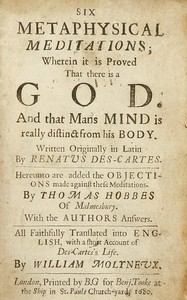
Six metaphysical meditations
free to read
length
33,711 words
a few pages a day
~8 min
finished in
18 days
full read
2h 20m
At Folio's default of ten pages a day, you finish Six metaphysical meditations in about 18 days — roughly 8 minutes of reading each morning.
The opening
the first pages of Six metaphysical meditations, free
A Collection of Letters for the improvement of Husbandry and Trade, intended to be continued Monthly, by John Houghton, fellow of the Royal Society, ’tis designed that every Letter shall be usefull to Mankind, and by degrees for most persons of both Sexes.
The Merchant Royal, (a very pleasant Sermon) Preached before the King at White-Hall, upon the Nuptials of an Honourable Lord and his Lady, in Quarto, price 6d.
Humane Prudence, or the Art by which a man may raise himself and Fortune to Granduer, by A. B., the second Edition, with the Addition of a Table; in Twelves, price Bound, 1s.
THE TRANSLATORS PREFACE.
TO THE READERS.
_Had honor or applause and not the publick advantage of English Readers been the design of this Undertaking, the consideration of the common Fate of Translations had discouraged Me from permitting this even to have seen the light; for meer Versions do alwayes carry with them this Property, that if not well done they may much disgrace, but if well, not much commend the doers._
_And certainly I might well have expected the same chance, had this been the Translation of an History, Play or Romance; wherein there is requisite not onely a bare version but a conformation of Idiom and language, manner and customary expression; But the nature of this present Work will not admit of the like liberty, and therefore, I hope, amongst Judicious Readers it may be exempt from the common Fate of Translations; for if we look upon it as a Philosophical or Metaphysical Tract, or rather as (really it is) a Physico-Mathematical Argumentation, we shall find that a great strictness of Expression is requisite to be observed therein. So that had a Translator taken upon him to use his own liberty of Phrase, he would thereby have endanger’d the sense and force of the Arguments; for Politeness of language might as well be expected in a Translation of ~Euclide~ as in this. And all that are acquainted with this famous Authors design, do very well know, that it was his intention in these Meditations ~Mathematically to demonstrate~, that there is a ~God~, and that mans ~mind~ is ~incorporeal~. And it was his opinion, that metaphysicks may as clearly be demonstrated as mathematicks, as witness his expression in the Dedicatory Epistle of this Work to the ~Sorbone~ Doctors, ~Eas~ (Rationes scilicet) ~quibus hic utor certitudine & evidentiâ Geometricas æquare, vel etiam superare existimem~; That he reputed his Arguments used in these Meditations, to equal if not excell Geometrical certainty._
_And this, I suppose, is sufficient to make the Reader, not expect herein any smoothness of phrase or quaintness of Expression; what is here delivered in English is immediately taken, as it is naturally in the Original. The words, we hope, may be apposite enough, and fit to express what is here designed, and I think it a derogation from the Authors skill to draw the Picture of his mind in any other Colours, than what his own Copy expresses._
_Thus far in vindication of the Philosophical plain stile and rough Language of the following Translation. I shall add a line or two, first relating to the Readers, secondly of the Author, and lastly of the Meditations themselves, together with the Motives which excited me to this Work._
_As to the Readers, ’tis, I suppose, so evident that candour of mind, and freedome from prejudice is requisite to all that desire to advantage themselves by reading other mens notions, that it need not be here insisted on with much earnestness; yet considering the Antiquity of this subject, and the novelty of the Arguments here produced, it seems to be more than ordinarily requisite for an impartial perusal of the ensuing Tract. Neither are the following Meditations to be slightly passed over, but with diligence and attention to be read; for as in mathematical demonstration, the careless missing of any one single Position may render the Conclusion obscure and sometimes inconsequent, so in these metaphysical Demonstrations, which (as, before has been noted from the illustrious Author thereof) for certainty do equal, if not excel Geometrical Propositions, the slight attention to any one particular Argument may frustrate the design of the whole discourse._
Keep going from exactly here — Folio remembers your place and serves the next portion tomorrow.
continue reading Six metaphysical meditationsAbout this free edition
Six metaphysical meditations by René Descartes (1596-1650) is free to read in full. Folio serves it in daily portions you can actually finish, tracks your streak and reading position across devices, and reads every page aloud with a built-in narrator. The text comes from Project Gutenberg.
More like Six metaphysical meditations
Discourse on the Method
Folio
Discourse on the Method
René Descartes
A Discourse of a Method for the Well Guiding of Reason
Folio
A Discourse of a Method for the Well Guiding of Reason
René Descartes
Selections from the Principles of Philosophy
Folio
Selections from the Principles of Philosophy
René Descartes
Meditations
Folio
Meditations
Marcus Aurelius
The Enchiridion
Epictetus

Thus Spake Zarathustra
Friedrich Nietzsche
Beyond Good and Evil
Folio
Beyond Good and Evil
Friedrich Nietzsche
The Genealogy of Morals
Folio
The Genealogy of Morals
Friedrich Nietzsche