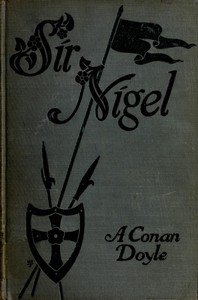
length
130,449 words
a few pages a day
~8 min
finished in
69 days
full read
9h 4m
At Folio's default of ten pages a day, you finish Sir Nigel in about 69 days — roughly 8 minutes of reading each morning.
The opening
the first pages of Sir Nigel, free
Dame History is so austere a lady that if one, has been so ill-advised as to take a liberty with her, one should hasten to make amends by repentance and confession. Events have been transposed to the extent of some few months in this narrative in order to preserve the continuity and evenness of the story. I hope so small a divergence may seem a venial error after so many centuries. For the rest, it is as accurate as a good deal of research and hard work could make it.
The matter of diction is always a question of taste and discretion in a historical reproduction. In the year 1350 the upper classes still spoke Norman-French, though they were just beginning to condescend to English. The lower classes spoke the English of the original Piers Plowman text, which would be considerably more obscure than their superiors’ French if the two were now reproduced or imitated. The most which the chronicles can do is to catch the cadence and style of their talk, and to infuse here and there such a dash of the archaic as may indicate their fashion of speech.
I am aware that there are incidents which may strike the modern reader as brutal and repellent. It is useless, however, to draw the Twentieth Century and label it the Fourteenth. It was a sterner age, and men’s code of morality, especially in matters of cruelty, was very different. There is no incident in the text for which very good warrant may not be given. The fantastic graces of Chivalry lay upon the surface of life, but beneath it was a half-savage population, fierce and animal, with little ruth or mercy. It was a raw, rude England, full of elemental passions, and redeemed only by elemental virtues. Such I have tried to draw it.
For good or bad, many books have gone to the building of this one. I look round my study table and I survey those which lie with me at the moment, before I happily disperse them forever. I see La Croix’s “Middle Ages,” Oman’s “Art of War,” Rietstap’s “Armorial General,” De la Borderie’s “Histoire de Bretagne,” Dame Berner’s “Boke of St. Albans,” “The Chronicle of Jocelyn of Brokeland,” “The Old Road,” Hewitt’s “Ancient Armour,” Coussan’s “Heraldry,” Boutell’s “Arms,” Browne’s “Chaucer’s England,” Cust’s “Scenes of the Middle Ages,” Husserand’s “Wayfaring Life,” Ward’s “Canterbury Pilgrims;” Cornish’s “Chivalry,” Hastings’ “British Archer,” Strutt’s “Sports,” Johnes Froissart, Hargrove’s “Archery,” Longman’s “Edward III,” Wright’s “Domestic Manners.” With these and many others I have lived for months. If I have been unable to combine and transfer their effect, the fault is mine.
ARTHUR CONAN DOYLE.
“UNDERSHAW,” November 30, 1905.
I. THE HOUSE OF LORING
In the month of July of the year 1348, between the feasts of St. Benedict and of St. Swithin, a strange thing came upon England, for out of the east there drifted a monstrous cloud, purple and piled, heavy with evil, climbing slowly up the hushed heaven. In the shadow of that strange cloud the leaves drooped in the trees, the birds ceased their calling, and the cattle and the sheep gathered cowering under the hedges. A gloom fell upon all the land, and men stood with their eyes upon the strange cloud and a heaviness upon their hearts. They crept into the churches where the trembling people were blessed and shriven by the trembling priests. Outside no bird flew, and there came no rustling from the woods, nor any of the homely sounds of Nature. All was still, and nothing moved, save only the great cloud which rolled up and onward, with fold on fold from the black horizon. To the west was the light summer sky, to the east this brooding cloud-bank, creeping ever slowly across, until the last thin blue gleam faded away and the whole vast sweep of the heavens was one great leaden arch.
Keep going from exactly here — Folio remembers your place and serves the next portion tomorrow.
continue reading Sir NigelAbout this free edition
Sir Nigel by Arthur Conan Doyle (1859-1930) is free to read in full. Folio serves it in daily portions you can actually finish, tracks your streak and reading position across devices, and reads every page aloud with a built-in narrator. The text comes from Project Gutenberg.
More like Sir Nigel
The Adventures of Sherlock Holmes
Arthur Conan Doyle
The Hound of the Baskervilles
Arthur Conan Doyle
A Study in Scarlet
Folio
A Study in Scarlet
Arthur Conan Doyle
The Sign of the Four
Arthur Conan Doyle
The Memoirs of Sherlock Holmes
Arthur Conan Doyle
The Return of Sherlock Holmes
Arthur Conan Doyle
His Last Bow
Arthur Conan Doyle
The Valley of Fear
Arthur Conan Doyle