
Round the World in Eighty Days
free to read
length
56,876 words
a few pages a day
~8 min
finished in
30 days
full read
3h 57m
At Folio's default of ten pages a day, you finish Round the World in Eighty Days in about 30 days — roughly 8 minutes of reading each morning.
The opening
the first pages of Round the World in Eighty Days, free
In the year of grace One thousand eight hundred and seventy-two, the house in which Sheridan died in 1816--viz. No. 7, Saville Row, Burlington Gardens--was occupied by Phileas Fogg, Esq., one of the most eccentric members of the Reform Club, though it always appeared as if he were very anxious to avoid remark. Phileas had succeeded to the house of one of England's greatest orators, but, unlike his predecessor, no one knew anything of Fogg, who was impenetrable, though a brave man and moving in the best society. Some people declared that he resembled Byron--merely in appearance, for he was irreproachable in tone--but still a Byron with whiskers and moustache: an impassible Byron, who might live a thousand years and not get old.
A thorough Briton was Phileas Fogg, though perhaps not a Londoner. He was never seen on the Stock Exchange, nor at the Bank of England, nor at any of the great City houses. No vessel with a cargo consigned to Phileas Fogg ever entered the port of London. He held no Government appointment. He had never been entered at any of the Inns of Court. He had never pleaded at the Chancery Bar, the Queen's Bench, the Exchequer, or the Ecclesiastical Courts. He was not a merchant, a manufacturer, a farmer, nor a man of business of any kind. He was not in the habit of frequenting the Royal Institution or any other of the learned societies of the metropolis. He was simply a member of the "Reform," and that was all!
If anyone ever inquired how it was that he had become a member of the club, the questioner was informed that he had been put up by the Barings, with whom he kept his account, which always showed a good balance, and from which his cheques were regularly and promptly honoured.
Was Phileas Fogg a rich man? Unquestionably. But in what manner he had made his money even the best-informed gossips could not tell, and Mr. Fogg was the very last person from whom one would seek to obtain information on the subject. He was never prodigal in expenditure, but never stingy; and whenever his contribution towards some good or useful object was required he gave cheerfully, and in many cases anonymously.
In short, he was one of the most uncommunicative of men. He talked little, and his habitual taciturnity added to the mystery surrounding him. Nevertheless, his life was simple and open enough, but he regulated all his actions with a mathematical exactness which, to the imagination of the quidnuncs, was in itself suspicious.
Had he ever travelled? It was very probable, for no one was better informed in the science of geography. There was apparently no out-of-the-way place concerning which he had not some exclusive information. Occasionally, in a few sentences, he would clear away the thousand-and-one rumours which circulated in the club concerning some lost or some nearly-forgotten traveller; he would point out the true probabilities; and it really appeared as if he were gifted with second sight, so correctly were his anticipations justified by succeeding events. He was a man who must have been everywhere--in spirit at least.
One thing at any rate was certain, viz. that he had not been absent from London for many a year. Those with whom he was on a more intimate footing used to declare that no one had ever seen him anywhere else but on his way to or from his club. His only amusement was a game of whist, varied by the perusal of the daily papers. At whist, which was a game peculiarly fitted to such a taciturn disposition as his, he was habitually a winner; but his gains always were expended in charitable objects. Besides, it was evident to everyone that Mr. Fogg played for the game, not for the sake of winning money. It was a trial of skill with him, a combat; but a fight unaccompanied by fatigue, and one entailing no great exertion, and thus suiting him "down to the ground!"
Keep going from exactly here — Folio remembers your place and serves the next portion tomorrow.
continue reading Round the World in Eighty DaysAbout this free edition
Round the World in Eighty Days by Jules Verne (1828-1905) is free to read in full. Folio serves it in daily portions you can actually finish, tracks your streak and reading position across devices, and reads every page aloud with a built-in narrator. The text comes from Project Gutenberg.
More like Round the World in Eighty Days
Godfrey Morgan
Folio
Godfrey Morgan
Jules Verne
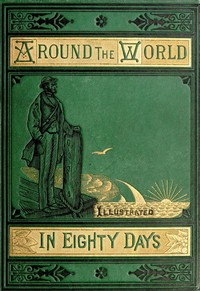
Around the World in Eighty Days
Jules Verne
Twenty Thousand Leagues Under the Sea
Folio
Twenty Thousand Leagues Under the Sea
Jules Verne
A Journey to the Centre of the Earth
Folio
A Journey to the Centre of the Earth
Jules Verne
The Mysterious Island
Folio
The Mysterious Island
Jules Verne
Michael Strogoff
Folio
Michael Strogoff
Jules Verne
Five Weeks in a Balloon
Jules Verne
The Fur Country
Folio
The Fur Country
Jules Verne