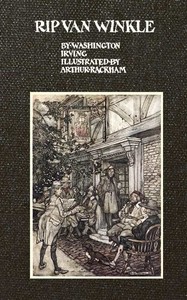
length
7,995 words
a few pages a day
~8 min
finished in
5 days
full read
33 min
At Folio's default of ten pages a day, you finish Rip Van Winkle in about 5 days — roughly 8 minutes of reading each morning.
The opening
the first pages of Rip Van Winkle, free
“Equipped in a pair of his father’s cast-off galligaskins, which he had as much ado to hold up as a fine lady does her train in bad weather” 4
“So that he was fain to draw off his forces and take to the outside of the house--the only side which, in truth, belongs to a henpecked husband.” 6
“A company of odd-looking persons playing at ninepins” 10
“They maintained the gravest faces” 12
“They stared at him with such fixed, statue-like gaze, that his heart turned within him and his knees smote together” 12
“He even ventured to taste the beverage, which he found had much of the flavour of excellent Hollands” 12
“Surely,” thought he, “I have not slept here all night.... Oh! that flagon! that wicked flagon! what excuse shall I make to Dame Van Winkle?” 12
“They all stared at him with equal marks of surprise and invariably stroked their chins” 14
“A troop of strange children ran at his heels, hooting after him and pointing at his grey beard” 14
“The dogs, too, not one of whom he recognised for an old acquaintance, barked at him as he passed” 14
“He found the house gone to decay.... ‘My very dog,’ sighed poor Rip, ‘has forgotten me’” 16
“They crowded round him, eyeing him from head to foot with great curiosity” 16
Rip’s daughter and grandchild 20
“He preferred making friends among the rising generation, with whom he soon grew into great favour” 24
“The Kaatsberg or Catskill mountains have always been a region full of fable” 26
They were ruled by an old squaw spirit 28
IN TEXT
Page
These fairy mountains 2
Long stories of ghosts, witches, and Indians 5
Peter was the most ancient inhabitant of the village 21
The Kaatskill mountains had always been haunted by strange beings 25
Very subject to marvellous events and appearances 30
When these clouds broke, woe betide the valleys 33
With a loud ho! ho! 35
[Illustration]
[Illustration]
By Woden, God of Saxons, From whence comes Wensday, that is Wodensday. Truth is a thing that ever I will keep Unto thylke day in which I creep into My sepulchre---- CARTWRIGHT.
[Illustration]
INTRODUCTION
The following tale was found among the papers of the late Diedrich Knickerbocker, an old gentleman of New York, who was very curious in the Dutch history of the province, and the manners of the descendants from its primitive settlers. His historical researches, however, did not lie so much among books as among men; for the former are lamentably scanty on his favourite topics; whereas he found the old burghers, and still more their wives, rich in that legendary lore so invaluable to true history. Whenever, therefore, he happened upon a genuine Dutch family, snugly shut up in its low-roofed farmhouse, under a spreading sycamore, he looked upon it as a little clasped volume of black-letter, and studied it with the zeal of a book-worm.
The result of all these researches was a history of the province during the reign of the Dutch governors, which he published some years since. There have been various opinions as to the literary character of his work, and, to tell the truth, it is not a whit better than it should be. Its chief merit is its scrupulous accuracy, which indeed was a little questioned on its first appearance, but has since been completely established; and it is now admitted into all historical collections as a book of unquestionable authority.
The old gentleman died shortly after the publication of his work; and now that he is dead and gone, it cannot do much harm to his memory to say that his time might have been much better employed in weightier labours. He, however, was apt to ride his hobby in his own way; and though it did now and then kick up the dust a little in the eyes of his neighbours, and grieve the spirit of some friends, for whom he felt the truest deference and affection, yet his errors and follies are remembered “more in sorrow than anger,” and it begins to be suspected that he never intended to injure or offend. But however his memory may be appreciated by critics, it is still held dear by many folks whose good opinion is well worth having; particularly by certain biscuit-bakers, who have gone so far as to imprint his likeness on their new-year cakes; and have thus given him a chance for immortality, almost equal to the being stamped on a Waterloo medal, or a Queen Anne’s farthing.
Keep going from exactly here — Folio remembers your place and serves the next portion tomorrow.
continue reading Rip Van WinkleAbout this free edition
Rip Van Winkle by Washington Irving (1783-1859) is free to read in full. Folio serves it in daily portions you can actually finish, tracks your streak and reading position across devices, and reads every page aloud with a built-in narrator. The text comes from Project Gutenberg.
More like Rip Van Winkle
Astoria
Folio
Astoria
Washington Irving
The Legend of Sleepy Hollow
Washington Irving
The Adventures of Captain Bonneville
Folio
The Adventures of Captain Bonneville
Washington Irving
Abbotsford and Newstead Abbey
Folio
Abbotsford and Newstead Abbey
Washington Irving
Oliver Goldsmith: A Biography
Folio
Oliver Goldsmith: A Biography
Washington Irving
Chronicle of the Conquest of Granada
Folio
Chronicle of the Conquest of Granada
Washington Irving
The Time Machine
H. G. Wells
The War of the Worlds
H. G. Wells