length
72,397 words
a few pages a day
~8 min
finished in
39 days
full read
5h 2m
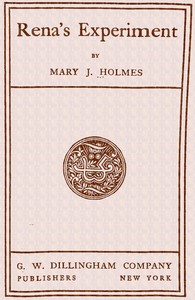
At Folio's default of ten pages a day, you finish Rena's experiment in about 39 days — roughly 8 minutes of reading each morning.
The opening
the first pages of Rena's experiment, free
A tall, angular woman, wearing a sun-bonnet and a big work apron which nearly covered her short dress, stood on the fence calling, “Charlotte Ann! Charlotte Ann! Charlotte Ann Parks! Where be you? Don’t you know it’s ’most noon, and the table not set? and Miss Bennett’s very partic’lar about her digester; and there’s a letter from the two summer boarders who are coming!”
The woman’s voice, strong and clear, went echoing down a grassy lane which led to a small grove, or thicket, of pine-woods in which was a shallow well, now seldom used except during a summer drought, when the cattle, which fed in the pasture-land around the woods, were watered from it. The old bucket and curb had fallen apart, and pieces of them were lying on the ground; but around the well were large, flat stones, one of which projected beyond the others a foot or more, so that a person standing upon it could look directly down into the centre of the water below. And it was on this projection that Charlotte Ann Parks was standing when her mother’s voice came warning her that it was nearly noon, that the table was not set, that Miss Bennett was particular about her “digester,” and there was a letter from the summer boarders. Charlotte Ann, or Lottie, as she was usually called by all except her mother, heard the call, but paid no attention. Her ear was strained to catch the first sound of the town clock in the village two miles away which would tell her that it was noon, and her eyes were fixed intently upon the small square mirror she held in her hand as nearly over the centre of the well as possible. She was trying a charm, or a trick, as it was designated in the rural district of Oakfield, where the traditions of a century ago had been handed down from generation to generation, and believed in, or discarded, according to the susceptibility of the people for the marvellous. Lottie always scoffed at the stories told of her great-grandmother’s time before the Revolution, when armies were seen passing and repassing in the heavens and the snow was like blood in the light of the Auroras; when houses were haunted and wizened old witch women rode through the air on broomsticks, or held their weird vigils in the woods which studded the wild New England coast. All this superstition had mostly died with the old people, whose gravestones in the Oakfield cemetery were sunken deep in the ground and so covered with mold and moss that it was impossible to read the date of their birth or death. A few oldtime customs, however, still clung to the young people, because of the romance attaching to them, rather than from any real faith in their efficacy. One of these had to do with the well in the pine-grove and the tragedy connected with it, the story of which I heard on the summer afternoon when I alighted at the little country station of Oakfield, dusty and tired, and wondering how I was to get to the place of my destination.
I was a stenographer and bookkeeper in a large city firm, and was overworked in body and brain. Sleep and appetite had both forsaken me, and I was sinking into a state of semi-invalidism, with little strength and less ambition. Rest I must have and a change of air, and when I saw an advertisement saying that Mrs. Eli Parks, who lived near the sea-coast and two miles from town, wanted summer boarders, and that her rooms were large and cool and quiet, and her house a hundred years old, I said: “That is the place for me; the fashionable world has not invaded Mrs. Parks. I can rest there. I will write her at once.”
I did write her, with the result that on a day in early July I was standing by my trunk and asking the station master if there was no means of conveyance for strangers who visited Oakfield?
“Why, yes,” he said; “of course there is. We ain’t so far behind as that. There’s a ’bus from town, here mostly for the trains. I don’t know why ’tain’t here now, only there don’t many come at this hour, or if they are comin’ they telegraph. Want to go to Miss Parks’? Well, you are in luck. That young chap there lives next to her. He’ll take you in his rig and I’ll send your traps bimeby. Hallo, you Sam! Come here!”
Keep going from exactly here — Folio remembers your place and serves the next portion tomorrow.
continue reading Rena's experimentAbout this free edition
Rena's experiment by Mary Jane Holmes (1825-1907) is free to read in full. Folio serves it in daily portions you can actually finish, tracks your streak and reading position across devices, and reads every page aloud with a built-in narrator. The text comes from Project Gutenberg.
More like Rena's experiment
Lucy Harding
Folio
Lucy Harding
Mary Jane Holmes
Tempest and Sunshine
Folio
Tempest and Sunshine
Mary Jane Holmes
The Rector of St. Mark's
Folio
The Rector of St. Mark's
Mary Jane Holmes
Darkness and Daylight: A Novel
Folio
Darkness and Daylight: A Novel
Mary Jane Holmes
Glen's Creek
Mary Jane Holmes
Marian Grey
Mary Jane Holmes
The Tracy diamonds
Mary Jane Holmes
Madeline
Mary Jane Holmes