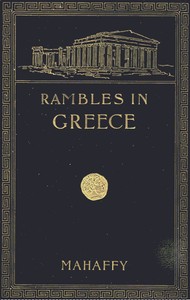
Rambles and Studies in Greece
free to read
length
136,161 words
a few pages a day
~8 min
finished in
72 days
full read
9h 27m
At Folio's default of ten pages a day, you finish Rambles and Studies in Greece in about 72 days — roughly 8 minutes of reading each morning.
The opening
the first pages of Rambles and Studies in Greece, free
Few men there are who having once visited Greece do not contrive to visit it again. And yet when the returned traveller meets the ordinary friend who asks him where he has been, the next remark is generally, “Dear me! have you not been there before? How is it you are so fond of going to Greece?” There are even people who imagine a trip to America far more interesting, and who at all events look upon a trip to Spain as the same kind of thing—southern climate, bad food, dirty inns, and general discomfort, odious to bear, though pleasant to describe afterward in a comfortable English home.
This is a very ignorant way of looking at the matter, for excepting Southern Italy, there is no country which can compare with Greece in beauty and interest to the intelligent traveller. It is not a land for creature comforts, though the climate is splendid, and though the hotels in Athens are as good as those in most European towns. It is not a land for society, though the society at Athens is excellent, and far easier of access than that of most European capitals. But if a man is fond of the large effects of natural scenery, he will find in the Southern Alps and fiords of Greece a variety and a richness of color which no other part of Europe affords. If he is fond of the details of natural scenery, flowers, shrubs, and trees, he will find the wild-flowers and flowering-trees of Greece more varied than anything he has yet seen. If he desires to study national character, and peculiar manners and customs, he will find in the hardy mountaineers of Greece one of the most unreformed societies, hardly yet affected by the great tide of sameness which is invading all Europe in dress, fabrics, and usages. And yet, in spite of the folly still talked in England about brigands, he will find that without troops, or police, or patrols, or any of those melancholy safeguards which are now so obtrusive in England and Ireland, life and property are as secure as they ever were in our most civilized homes. Let him not know a word of history, or of art, and he will yet be rewarded by all this natural enjoyment; perhaps also, if he be a politician, he may study the unsatisfactory results of a constitution made to order, and of a system of free education planted in a nation of no political training, but of high intelligence.
Need I add that as to Cicero the whole land was one vast shrine of hallowed memories—quocunque incedis, historia est—so to the man of culture this splendor of associations has only increased with the lapse of time and the greater appreciation of human perfection. Even were such a land dead to all further change, and a mere record in its ruins of the past, I know not that any man of reflection could satisfy himself with contemplating it. Were he to revisit the Parthenon, as it stands, every year of his life, it would always be fresh, it would always be astonishing. But Greece is a growing country, both in its youth and in its age. The rapid development of the nation is altering the face of the country, establishing new roads and better communications, improving knowledge among the people, and making many places accessible which were before beyond the reach of brief holiday visits. The insecurity which haunted the Turkish frontier has been pushed back to the north; new Alps and new monasteries are brought within the range of Greece. And this is nothing to what has been done in recovering the past. Every year there are new excavations made, new treasures found, new problems in archæology raised, old ones solved; and so at every visit there is a whole mass of new matter for the student who feels he had not yet grasped what was already there.
Keep going from exactly here — Folio remembers your place and serves the next portion tomorrow.
continue reading Rambles and Studies in GreeceAbout this free edition
Rambles and Studies in Greece by J. P. Mahaffy (1839-1919) is free to read in full. Folio serves it in daily portions you can actually finish, tracks your streak and reading position across devices, and reads every page aloud with a built-in narrator. The text comes from Project Gutenberg.
More like Rambles and Studies in Greece
Problems in Greek history
Folio
Problems in Greek history
J. P. Mahaffy
The History of the Peloponnesian War
Folio
The History of the Peloponnesian War
Thucydides
The History of Herodotus
Folio
The History of Herodotus
Herodotus
The Gallic Wars
Folio
The Gallic Wars
Julius Caesar
Anabasis
Folio
Anabasis
Xenophon
The Lives of the Twelve Caesars
Folio
The Lives of the Twelve Caesars
Suetonius
Germania
Folio
Germania
Tacitus

The History of the Decline and Fall of the Roman Empire
Edward Gibbon