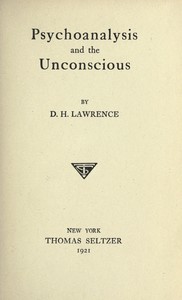
Psychoanalysis and the unconscious
free to read
length
15,495 words
a few pages a day
~8 min
finished in
9 days
full read
1h 5m
At Folio's default of ten pages a day, you finish Psychoanalysis and the unconscious in about 9 days — roughly 8 minutes of reading each morning.
The opening
the first pages of Psychoanalysis and the unconscious, free
Psychoanalysis has sprung many surprises on us, performed more than one volte face before our indignant eyes. No sooner had we got used to the psychiatric quack who vehemently demonstrated the serpent of sex coiled round the root of all our actions, no sooner had we begun to feel honestly uneasy about our lurking complexes, than lo and behold the psychoanalytic gentleman reappeared on the stage with a theory of pure psychology. The medical faculty, which was on hot bricks over the therapeutic innovations, heaved a sigh of relief as it watched the ground warming under the feet of the professional psychologists.
This, however, was not the end. The ears of the ethnologist began to tingle, the philosopher felt his gorge rise, and at last the moralist knew he must rush in. By this time psychoanalysis had become a public danger. The mob was on the alert. The Œdipus complex was a household word, the incest motive a commonplace of tea-table chat. Amateur analyses became the vogue. “Wait till you’ve been analyzed,” said one man to another, with varying intonation. A sinister look came into the eyes of the initiates—the famous, or infamous, Freud look. You could recognize it everywhere, wherever you went.
Psychoanalysts know what the end will be. They have crept in among us as healers and physicians; growing bolder, they have asserted their authority as scientists; two more minutes and they will appear as apostles. Have we not seen and heard the ex cathedra Jung? And does it need a prophet to discern that Freud is on the brink of a Weltanschauung—or at least a Menschanschauung, which is a much more risky affair? What detains him? Two things. First and foremost, the moral issue. And next, but more vital, he can’t get down to the rock on which he must build his church.
Let us look to ourselves. This new doctrine—it will be called no less—has been subtly and insidiously suggested to us, gradually inoculated into us. It is true that doctors are the priests, nay worse, the medicine-men of our decadent society. Psychoanalysis has made the most of the opportunity.
First and foremost the issue is a moral issue. It is not here a matter of reform, new moral values. It is the life or death of all morality. The leaders among the psychoanalysts know what they have in hand. Probably most of their followers are ignorant, and therefore pseudo-innocent. But it all amounts to the same thing. Psychoanalysis is out, under a therapeutic disguise, to do away entirely with the moral faculty in man. Let us fling the challenge, and then we can take sides in all fairness.
The psychoanalytic leaders know what they are about, and shrewdly keep quiet, going gently. Yet, however gently they go, they set the moral stones rolling. At every step the most innocent and unsuspecting analyst starts a little landslide. The old world is yielding under us. Without any direct attack, it comes loose under the march of the psychoanalyst, and we hear the dull rumble of the incipient avalanche. We are in for a debâcle.
But at least let us know what we are in for. If we are to rear a serpent against ourselves, let us at least refuse to nurse it in our temples or to call it the cock of Esculapius. It is time the white garb of the therapeutic cant was stripped off the psychoanalyst. And now that we feel the strange crackling and convulsion in our moral foundations, let us at least look at the house which we are bringing down over our heads so blithely.
Long ago we watched in frightened anticipation when Freud set out on his adventure into the hinterland of human consciousness. He was seeking for the unknown sources of the mysterious stream of consciousness. Immortal phrase of the immortal James! Oh stream of hell which undermined my adolescence! The stream of consciousness! I felt it streaming through my brain, in at one ear and out at the other. And again I was sure it went round in my cranium, like Homer’s Ocean, encircling my established mind. And sometimes I felt it must bubble up in the cerebellum and wind its way through all the convolutions of the true brain. Horrid stream! Whence did it come, and whither was it bound? The stream of consciousness!
Keep going from exactly here — Folio remembers your place and serves the next portion tomorrow.
continue reading Psychoanalysis and the unconsciousAbout this free edition
Psychoanalysis and the unconscious by D. H. Lawrence (1885-1930) is free to read in full. Folio serves it in daily portions you can actually finish, tracks your streak and reading position across devices, and reads every page aloud with a built-in narrator. The text comes from Project Gutenberg.
More like Psychoanalysis and the unconscious

Glad Ghosts
D. H. Lawrence
Sons and Lovers
D. H. Lawrence
Women in Love
Folio
Women in Love
D. H. Lawrence

Lady Chatterley's Lover
D. H. Lawrence
The Trespasser
Folio
The Trespasser
D. H. Lawrence
The Lost Girl
Folio
The Lost Girl
D. H. Lawrence
Fantasia of the Unconscious
Folio
Fantasia of the Unconscious
D. H. Lawrence
Meditations
Folio
Meditations
Marcus Aurelius