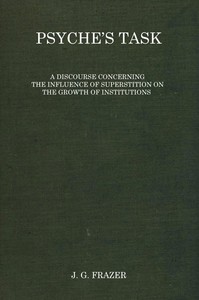
length
79,874 words
a few pages a day
~8 min
finished in
43 days
full read
5h 33m
At Folio's default of ten pages a day, you finish Psyche's task in about 43 days — roughly 8 minutes of reading each morning.
The opening
the first pages of Psyche's task, free
Good and evil we know in the field of this world grow up together almost inseparably; and the knowledge of good is so involved and interwoven with the knowledge of evil and in so many cunning resemblances hardly to be discerned, that those confused seeds, which were imposed on Psyche as an incessant labour to cull out and sort asunder, were not more intermixt.
Milton, Areopagitica.
Il ne faut pas croire cependant qu’un mauvais principe vicie radicalement une institution, ni même qu’il y fasse tout le mal qu’il porte dans son sein. Rien ne fausse plus l’histoire que la logique: quand l’esprit humain s’est arrêté sur une idée, il en tire toutes les conséquences possibles, lui fait produire tout ce qu’en effet elle pourrait produire, et puis se la représente dans l’histoire avec tout ce cortège. Il n’en arrive point ainsi; les événements ne sont pas aussi prompts dans leur déductions que l’esprit humain. Il y a dans toutes choses un mélange de bien et de mal si profond, si invincible que, quelque part que vous pénétriez, quand vous descendrez dans les derniers éléments de la société ou de l’âme, vous y trouverez ces deux ordres de faits coexistant, se développant l’un à côté de l’autre et se combattant, mais sans s’exterminer. La nature humaine ne va jamais jusqu’aux dernières limites, ni du mal ni du bien; elle passe sans cesse de l’un à l’autre, se redressant au moment où elle semble le plus près de la chute, faiblissant au moment où elle semble marcher le plus droit.
Guizot, Histoire de la civilisation dans l’Europe, Cinquième Leçon.
[DEDICATION]
TO ALL WHO ARE ENGAGED IN PSYCHE’S TASK OF SORTING OUT THE SEEDS OF GOOD FROM THE SEEDS OF EVIL I DEDICATE THIS DISCOURSE
PREFACE
{vii}
The substance of the following discourse was lately read at an evening meeting of the Royal Institution in London, and most of it was afterwards delivered in the form of lectures to my class at Liverpool. It is now published in the hope that it may call attention to a neglected side of superstition and stimulate enquiry into the early history of those great institutions which still form the framework of modern society. If it should turn out that these institutions have sometimes been built on rotten foundations, it would be rash to conclude that they must all come down. Man is a very curious animal, and the more we know of his habits the more curious does he appear. He may be the most rational of the beasts, but certainly he is the most absurd. Even the saturnine wit of Swift, unaided by a knowledge of savages, fell far short of the reality in his attempt to set human folly in a strong light. Yet the odd thing is that in spite, or perhaps by virtue, of his absurdities man moves steadily upwards; the more we learn of his past history the more groundless does the old theory of his degeneracy prove to be. From false premises he often arrives at sound conclusions: from a chimerical theory he deduces a salutary practice. This discourse will have served a useful purpose if it illustrates a few {viii} of the ways in which folly mysteriously deviates into wisdom, and good comes out of evil. It is a mere sketch of a vast subject. Whether I shall ever fill in these bald outlines with finer strokes and deeper shadows must be left to the future to determine. The materials for such a picture exist in abundance; and if the colours are dark, they are yet illuminated, as I have tried in this essay to point out, by a ray of consolation and hope.
Keep going from exactly here — Folio remembers your place and serves the next portion tomorrow.
continue reading Psyche's taskAbout this free edition
Psyche's task by James George Frazer (1854-1941) is free to read in full. Folio serves it in daily portions you can actually finish, tracks your streak and reading position across devices, and reads every page aloud with a built-in narrator. The text comes from Project Gutenberg.
More like Psyche's task
Meditations
Folio
Meditations
Marcus Aurelius
The Enchiridion
Epictetus

Thus Spake Zarathustra
Friedrich Nietzsche
Beyond Good and Evil
Folio
Beyond Good and Evil
Friedrich Nietzsche
The Genealogy of Morals
Folio
The Genealogy of Morals
Friedrich Nietzsche
The Republic
Folio
The Republic
Plato
Apology
Folio
Apology
Plato
Crito
Folio
Crito
Plato