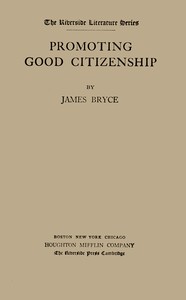
length
13,617 words
a few pages a day
~8 min
finished in
8 days
full read
57 min
At Folio's default of ten pages a day, you finish Promoting good citizenship in about 8 days — roughly 8 minutes of reading each morning.
The opening
the first pages of Promoting good citizenship, free
The two essays by Mr. James Bryce included in this volume are reprinted by permission of Yale University from Mr. Bryce’s lectures on the Dodge Foundation, published in book form by the Yale University Press under the title of The Hindrances to Good Citizenship.
INTRODUCTION
Mr. Bryce has for a long time been a man of international prominence. His wide influence is undoubtedly due to many causes, but it may, in general, be traced to two characteristics: Mr. Bryce is a humanist who sympathetically watches the progress of nations and the guiding of governments; he is also a historian. In his biographical study of John Richard Green he has skillfully analyzed the aptitudes of the historian, and in so doing has pointedly, if unwittingly, described himself. Accuracy, he says,--a desire for the exact truth,--keen observation, sound judgment, imagination, and, following inevitably from these, command of literary exposition, are the powers which a historian needs. Each of these qualities Mr. Bryce himself possesses in large measure. It is his historical power, enabling him to observe and record the significant phases and events of human life, plus his sympathetic interest in its present-day manifestations which explain, in some degree, his singularly eminent position as an authority on matters pertaining to human institutions in various countries.
Mr. Bryce was born in northern Ireland in 1838, of Scotch-Irish parents; and he combines in his nature the stalwart intellectual propensities of the Scot and the artistic attributes of the Celt. He was educated at the University of Glasgow, and later went to Oxford where he won many honors. After finishing his collegiate work he was admitted to the bar and practiced law in London until 1882. At the age of thirty-two he was appointed Regius Professor of Civil Law at Oxford. Up to this point his life had been almost exclusively that of a student and a scholar; and already at this time he was recognized as a man of remarkable historical ability. The year 1880 marked a change in his life. He presented himself to the workingmen of Tower Hamlets, London, as a candidate for a seat in the House of Commons. Mr. Stead tells us that Mr. Bryce, in this first campaign, addressed his open-air audiences somewhat after the manner of a professor lecturing in a classroom; he succeeded, nevertheless, in getting himself elected, and for over twenty-five years thereafter was a member of Parliament. During these years he held various responsible offices having to do with home and foreign administrative work. The practical results of his political influence were advancement in public education, the securing of more extensive parks and open country spaces for the pleasure of the poorer classes, and the furtherance of international peace. In 1907, Mr. Bryce was appointed ambassador to the United States, which office he resigned in 1913 to carry on literary work.
Mr. Bryce’s knowledge is the result not only of university training and experience in public life, but also of varied reading. He has read art, science, history, and has always been an interested student of poetry. In speaking once to Americans of Swinburne, he suddenly paused and asked, “Who are writing your songs and stirring your heart,--or isn’t your heart being stirred? Nothing is more important than that each generation and each land should have its poets. Each oncoming tide of life, each age, requires and needs men of lofty thought who shall dream and sing for it, who shall gather up its tendencies and formulate its ideals and voice its spirit, proclaiming its duties and awakening its enthusiasm, through the high authority of the poet and the art of his verse.” How extensively Mr. Bryce has read the poets, both ancient and modern, one perceives from the references and allusions in his Studies in Contemporary Biography.
Keep going from exactly here — Folio remembers your place and serves the next portion tomorrow.
continue reading Promoting good citizenshipAbout this free edition
Promoting good citizenship by James Bryce Viscount Bryce (1838-1922) is free to read in full. Folio serves it in daily portions you can actually finish, tracks your streak and reading position across devices, and reads every page aloud with a built-in narrator. The text comes from Project Gutenberg.
More like Promoting good citizenship
William Ewart Gladstone
Folio
William Ewart Gladstone
James Bryce, Viscount Bryce
Studies in Contemporary Biography
Folio
Studies in Contemporary Biography
James Bryce Viscount Bryce
The Holy Roman Empire
James Bryce, Viscount Bryce
Impressions of South Africa
Folio
Impressions of South Africa
James Bryce Viscount Bryce
Meditations
Folio
Meditations
Marcus Aurelius
The Enchiridion
Epictetus
Thus Spake Zarathustra
Friedrich Nietzsche
Beyond Good and Evil
Folio
Beyond Good and Evil
Friedrich Nietzsche