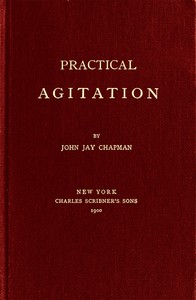
length
33,501 words
a few pages a day
~8 min
finished in
18 days
full read
2h 20m
At Folio's default of ten pages a day, you finish Practical Agitation in about 18 days — roughly 8 minutes of reading each morning.
The opening
the first pages of Practical Agitation, free
This book is an attempt to follow the track of personal influence across society. The first three chapters are taken up with discussions of political reform, the fourth chapter with contemporary journalism. The results of these discussions are then summarized in the chapters called “Principles.”
I know that there are as many ways of stating the main idea of the book as there are minds in the world. That idea is, that we can always do more for mankind by following the good in a straight line than we can by making concessions to evil. The illusion that it is wise or necessary to suppress our instinctive love of truth comes from an imperfect understanding of what that instinctive love of truth represents, and of what damage happens both to ourselves and to others when we suppress it. The more closely we look at the facts, the more serious does this damage appear. And on the other hand, the more closely we look at the facts, the more trifling, inconsequent, and absurd do all those reasons appear which strive to make us accept, and thereby sanctify and preserve, some portion of the conceded evil in the world.
J. J. C. NEW YORK, February 5, 1900.
CONTENTS
PAGE
I. ELECTION TIME 1
II. BETWEEN ELECTIONS 34
III. THE MASSES 67
IV. LITERATURE 83
V. PRINCIPLES 104
VI. PRINCIPLES (continued) 126
VII. CONCLUSION 135
PRACTICAL AGITATION
I
ELECTION TIME
It is the ambition of the agitator to use the machinery of government to make men more unselfish. In so far as he succeeds in this, he is creating a living church, the only sort of State church that would be entirely at one with our system, because it would be merely a representation in the formal government of a spirit abroad among the people.
Campaign platforms are merely creeds. “I believe in Civil Service Reform” is a way of saying “I do not believe in theft,” and the phrase was a fragmentary and incomplete formulation of the greater truth. It was the sign that a movement was beginning among the people due to reawakening instinct, reawakening sensibility. It was the forerunner of all those changes for the better that have been spreading over our administrative government during the last thirty years. A quiet revolution has been going forward under our eyes, recorded step by step. It is only because our standards have been going up faster than the reforms came in that we believe the evils are growing worse. Such changes go on all the time all over the world, but the value and rarity of this one come from its unity and coherence. Such a thing might happen in Germany or in England, but you could not disentangle the forces.
Thirty years ago politics was thought to be no occupation for a gentleman. It was a matter of bar-rooms, ballot-box-stuffing, rolls of dirty bills. You had as little to do with it as possible. You voted your party ticket, you paid your taxes. You bribed the ashman and the policeman at your uptown house, and the clerk of the court, the inspector, the custom-house agent, and the commissioner of jurors at your office.
That subtle change of attitude in the citizen towards his public duty which is now in progress, has in it something of the religious. The whole matter becomes comprehensible the moment we cease to think of it as politics, and see in it a widespread and perfectly natural reaction against an era of wickedness. Had our framework of government afforded no outlet to the force, had our ills been irremediably crystallized into formal tyranny, we should perhaps have witnessed great revivalist upheavals, sacraments, saints, prophets, prostrations, and adoration. As it is, we have seen deadly pamphlets, schedules, enactments, documents which it required our whole attention and our whole time to understand; and behind each of them a remorseless interrogator with a white cravat and a face of iron. What motive drives them on? What oil fills their lamps? Who feeds them? These horrid things they bring, these instruments forged by unremitting toil, technical, insufferable,--they are the cure. With such levers, and with them only, can the stones be lifted off the hearts of men. They are the alternatives of revolution.
Keep going from exactly here — Folio remembers your place and serves the next portion tomorrow.
continue reading Practical AgitationAbout this free edition
Practical Agitation by John Jay Chapman (1862-1933) is free to read in full. Folio serves it in daily portions you can actually finish, tracks your streak and reading position across devices, and reads every page aloud with a built-in narrator. The text comes from Project Gutenberg.
More like Practical Agitation
Meditations
Folio
Meditations
Marcus Aurelius
The Enchiridion
Epictetus

Thus Spake Zarathustra
Friedrich Nietzsche
Beyond Good and Evil
Folio
Beyond Good and Evil
Friedrich Nietzsche
The Genealogy of Morals
Folio
The Genealogy of Morals
Friedrich Nietzsche
The Republic
Folio
The Republic
Plato
Apology
Folio
Apology
Plato
Crito
Folio
Crito
Plato