length
53,689 words
a few pages a day
~8 min
finished in
29 days
full read
3h 44m
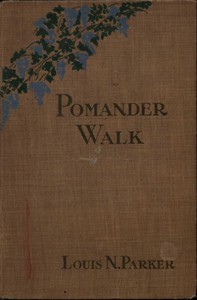
At Folio's default of ten pages a day, you finish Pomander Walk in about 29 days — roughly 8 minutes of reading each morning.
The opening
the first pages of Pomander Walk, free
It lies out Chiswick way, not far from Horace Walpole's house where later Miss Pinkerton conducted her Academy for Young Ladies. It is still there, although it was actually built in 1710; but London has gradually stretched its tentacles towards it, and they will soon absorb it. Where Marjolaine and Jack made love, there will be a row of blatant shops, and Sir Peter's house will be replaced by a flaring gin-palace. It has fallen from its high estate nowadays; and Mrs. Poskett's prophecy has come true: one of its dainty houses--I think it is the one in which the Misses Pennymint lived--is now indeed occupied by a person who earns a precarious living with a mangle.
Even in the days I am writing about, it was old--ninety-five years old--and had seen many ups and downs; for I am writing of events that took place in 1805: the year of Trafalgar; the year of Nelson's death.
At that time it was a charming, quaint little crescent of six very small red-brick houses, close to the Thames, facing due south, and with a beautiful view across the river.
Why it was called Pomander Walk is more than I can tell you. There is a tradition that the builder had inherited a beautiful gold pomander of Venetian filigree and that the word struck him as being pretty and having an old-world flavour about it. It certainly conferred a sort of quiet dignity on the crescent; almost too much dignity, indeed, at first, for it seemed to make the letting of the houses difficult. Common people fought shy of it, because of the name, yet the houses were so small that wealthy folk--the Quality--wouldn't look at them. Ultimately, however, they were occupied by gentlefolk in reduced circumstances; people who had an eye for the picturesque, people who sought retirement; and the owner was happy.
In 1805 it had grown mellow with age. The red bricks of which it was built had lost the crudeness of their original colour and had acquired a delicious tone restful to the eye. Pomander Walk was, in fact, one of the prettiest nooks near London. It stood--and stands--on a little plot of ground projecting into the river. At the upper end it was cut off from the rest of the parish of Chiswick by Pomander Creek, which ran a long way inland and formed a sort of refuge for lazy barges, one of which was generally lying there with its great brown sail hanging loose to dry. Chiswick Parish Church was only a little way across the creek, but in order to get to it you had to walk very nearly a mile to the first bridge, and I am afraid Sir Peter Antrobus too often made that an excuse for not attending more than two services on a Sunday.
The little houses were built in the sober and staid style introduced during the reign of Her Gracious Majesty Queen Anne (now deceased). The architect had taken a slily humorous delight in making them miniature copies of much more pretentious town mansions. Each little house had its elaborate door with a shell-shaped lintel; each had its miniature front-garden, divided from the road-way by elaborate iron railings; and each had an ornate iron gate with link-extinguisher complete. You might have thought the houses were meant to be inhabited by very small Dukes, so stately were they in their tiny way. The ground-floor sitting-rooms all had bow-windows, and in each bow-window the occupants displayed their dearest treasures, generally under a glass globe. A glance at these would almost have been enough to tell you what manner of people their owners were. In the first, at the top corner of the crescent, stood the model of a man-of-war. The second displayed a silver cup with the arms of the City of London carefully turned outward for the passer-by to admire respectfully; the third showed a stuffed canary; the fourth was empty--I will tell you why later; the fifth presented a pinchbeck snuff-box, and in the sixth there was an untidy pile of old books.
Keep going from exactly here — Folio remembers your place and serves the next portion tomorrow.
continue reading Pomander WalkAbout this free edition
Pomander Walk by Louis Napoleon Parker (1852-1944) is free to read in full. Folio serves it in daily portions you can actually finish, tracks your streak and reading position across devices, and reads every page aloud with a built-in narrator. The text comes from Project Gutenberg.
More like Pomander Walk

Pride and Prejudice
Jane Austen

Sense and Sensibility
Jane Austen
Emma
Folio
Emma
Jane Austen
Persuasion
Folio
Persuasion
Jane Austen
Mansfield Park
Folio
Mansfield Park
Jane Austen
Jane Eyre
Charlotte Brontë
The Tenant of Wildfell Hall
Folio
The Tenant of Wildfell Hall
Anne Brontë
Agnes Grey
Folio
Agnes Grey
Anne Brontë