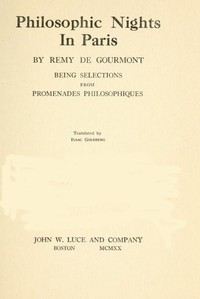
length
23,459 words
a few pages a day
~8 min
finished in
13 days
full read
1h 38m
At Folio's default of ten pages a day, you finish Philosophic Nights in Paris in about 13 days — roughly 8 minutes of reading each morning.
The opening
the first pages of Philosophic Nights in Paris, free
The importance of Remy de Gourmont to the universal world of thought is now beginning to be recognized among thinkers of every continent. During his own life he was a figure apart and aloof even from his confrères; his reputation was a matter more of intensity than of extensive acclaim, although subtly it made its way, as did that of the Symbolist school in general, to many nations. Now, however, he is beginning to receive that wider recognition which during his life he actually shunned. He belongs with the notable few who have devised and lived a philosophy of continuous adaptation to the new knowledge that the new day brings forth; he is a daring, independent, unostentatious, extremely personal neo-Epicurean, too individualistic to have been held long within the circle of a school, too sensitive not to have responded to the multifarious influences of a complex age. Yet just as his individualism was not the ignorant self-proclamation of blatant mediocrity, so was his response to the contemporary world far more than an aimless dashing about hither and thither in a snobbish attempt to be ahead of the times. The man's essentially dynamic personality has a genuine strain of the classic in it; he possesses a rare repose, an intellectual poise, that serves as a most admirable complement to his vibrant ideas. Few writers have ever so well combined matter and manner, which to Gourmont were but two aspects of one and the same thing,--the original thought. He is not, and never will be, a writer for the crowd; he was, by heredity and by choice, an aristocratic spirit, yet as he lived grew to recognize and to admit the importance of true democracy.
His chief importance, historically, was as the recognized interpreter of the Symbolistic movement in French poetry; but behind that movement lay a genealogy of ideas which ramified into such seemingly divergent directions as the pre-Raphaelites in England, the Hegelian idealists in Germany, and thus formed a modern manifestation of primary significance. De Gourmont, like more than one of the Symbolists, outgrew the movement, which from the first was composed of personalities too strong to form a mere school. He was, in the words of one of his commentators, "among the first, if not the first, to realize the insufficiency of Symbolism, in all that did not confine itself amidst the proud ivory walls of an uncompromising lyricism. If he did not combat it, because he had too complaisantly exalted it, he none the less abandoned it more and more, to surrender himself,--with no other discipline than his personal taste and his keen sense of the French genius,--to the fecundity of his nature, retaining of the old verbal magic only that which might contribute to his personal expansion,--notably that precious gift of image and analogies which imparts such poetry, such flexibility, variety and charm to his style. But henceforth the idea (i.e., rather than the word) assumed in him a preponderant importance, and now he was to play with ideas.... as he had previously played with words and images."
II
Gourmont's literary career was particularly identified with the notable French Review, the Mercure de France. How he came to join the staff of that organ is interestingly recounted by Louis Dumur, in the same obituary note from which the above quotation was translated. Incidentally we obtain a glimpse of the young man just as he was emerging into note.
"The great writer whom we have just lost," wrote M. Dumur, "was to us more than a friend, better than a master: he seemed to us the most complete representative, the very expression,--in all its aspects and in all its complexity,--of our literary generation.
"When, in the autumn of 1889, the small group which proposed to found the Mercure de France thought first of adding several collaborators to its number," while one went off in search of Jules Renard, another invited Julien Leclercq and a third promised the assistance of Albert Samain,--the late lamented Louis Denise, who was at that time cataloguer of the Bibliothèque Nationale, said to us:
"There is at the Library an extraordinary man who knows everything. He has already published ten volumes and a hundred articles upon every conceivable subject."
Keep going from exactly here — Folio remembers your place and serves the next portion tomorrow.
continue reading Philosophic Nights in ParisAbout this free edition
Philosophic Nights in Paris by Remy de Gourmont (1858-1915) is free to read in full. Folio serves it in daily portions you can actually finish, tracks your streak and reading position across devices, and reads every page aloud with a built-in narrator. The text comes from Project Gutenberg.
More like Philosophic Nights in Paris
A Night in the Luxembourg
Remy de Gourmont
The Natural Philosophy of Love
Remy de Gourmont
Meditations
Folio
Meditations
Marcus Aurelius

The Enchiridion
Epictetus

Thus Spake Zarathustra
Friedrich Nietzsche
Beyond Good and Evil
Folio
Beyond Good and Evil
Friedrich Nietzsche
The Genealogy of Morals
Folio
The Genealogy of Morals
Friedrich Nietzsche
The Republic
Folio
The Republic
Plato