length
3,169 words
a few pages a day
~8 min
finished in
2 days
full read
13 min
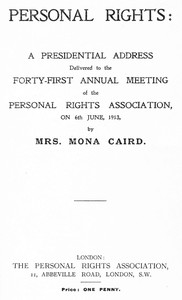
At Folio's default of ten pages a day, you finish Personal Rights in about 2 days — roughly 8 minutes of reading each morning.
The opening
the first pages of Personal Rights, free
LADIES AND GENTLEMEN:—I used to feel some impatience with public speakers who spent half their speech in explaining how it was they had committed the indiscretion of making it, and how much more suitable for the post somebody else would have been.
Those gentlemen now have my profoundest sympathy!
I feel that I ought to spend not half, but my whole speech, in explaining why I have the temerity to address you tonight on this familiar subject, seeing that I never do speak in public, and that my feelings about taking the chair are very much like they would be about taking a cold plunge in the Atlantic in early spring.
However, I can’t get rid of my deficiencies by enumerating them, so I must just throw myself on your mercy, asking you to regard this venture as a tribute of admiration and gratitude to our President and his supporters who have made so magnificent a defence of the Cause for so many thankless years. Also I have felt moved to accept the honour on account of the scarcity of wholehearted champions, especially—I regret to hear—among the sex which has always been deprived of personal rights.
Perhaps that is just why they are lacking in respect for them! And what a warning this is! The spirit of liberty, it would appear, can be starved to death. Society, having done its foolish best to destroy that spirit in half its members, expects the other half to retain it unimpaired—an obvious impossibility. For interaction of influence is incessant and universal between the two sexes.
The career of women having depended not on right but on favour, they have learnt to care little for an abstract idea which has no bearing on their lives. Only the exceptional mind cares for that. But similar conditions would assuredly produce the same result in men. And—we are on our rapid way to similar conditions.
Now, in a vast subject like this, which really touches the heart of everything that is vital and valuable in life, it is impossible, in twenty-five minutes to deal with it in any detail; and I propose tonight simply to dwell upon the perils with which we are all threatened, in consequence of the present trend of sentiment. For we have to try and make these perils obvious to the hearts as well as to the minds of our contemporaries, if there is to be any hope of checking the present downward tendencies.
It is of little use merely stating that it is perilous to try to purchase social benefits at the expense of individuals. To the majority, that seems the safest thing in the world; and, strange to say, the most just. The ancient idea of vicarious sacrifice is as rampant today as it was when the groves of ancient temples echoed with the cries of human victims, burnt on the altars, for the appeasement of the gods and the good of the community.
The idea of numbers enters largely into the popular idea of right and wrong—what I call arithmetical morality. Because 100 is ten times more than 10, it is assumed that ten persons may justly be sacrificed for the sake of the 100. But that is to confuse mere nonsentient signs with living conscious beings; surely a strangely stupid proceeding. It is this deeply-rooted idea which we have to combat.
First of all then, it must be noted, that, as a rule, the less liberty people enjoy, the less they value or respect it. The preoccupation will be not with liberty but with the best means of getting on without it. And the best way of doing that will be—or will seem to be—to force your own views as much as possible upon your neighbours—otherwise they will force theirs upon you. Mutually lacking in respect for liberty, there will be as many good reasons for attacking it in others as you have theories to enforce. And the same for them. The situation must obviously end in a stupendous tyranny of some kind: whether of king or oligarchy or State: and that of the State, being practically invulnerable, is the worst of all.
Keep going from exactly here — Folio remembers your place and serves the next portion tomorrow.
continue reading Personal RightsAbout this free edition
Personal Rights by Mona Caird (1854-1932) is free to read in full. Folio serves it in daily portions you can actually finish, tracks your streak and reading position across devices, and reads every page aloud with a built-in narrator. The text comes from Project Gutenberg.
More like Personal Rights
Meditations
Folio
Meditations
Marcus Aurelius

The Enchiridion
Epictetus

Thus Spake Zarathustra
Friedrich Nietzsche
Beyond Good and Evil
Folio
Beyond Good and Evil
Friedrich Nietzsche
The Genealogy of Morals
Folio
The Genealogy of Morals
Friedrich Nietzsche
The Republic
Folio
The Republic
Plato
Apology
Folio
Apology
Plato
Crito
Folio
Crito
Plato