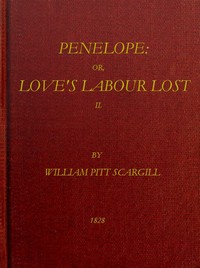
length
52,809 words
a few pages a day
~8 min
finished in
28 days
full read
3h 40m
At Folio's default of ten pages a day, you finish Penelope in about 28 days — roughly 8 minutes of reading each morning.
The opening
the first pages of Penelope, free
Lord Spoonbill was not less disappointed than the Countess of Smatterton, to hear that Penelope was in daily expectation of seeing her father. Hereditary legislators are sometimes perplexed, and in the present case the son of the Earl of Smatterton was in a state of grievous doubt and agitation.
His object in the first instance had been to take Penelope under his protection, and he supposed that if the correspondence between her and Robert Darnley could be broken off, there would be very little difficulty in inducing her to comply with his proposals. For it was his intention to make a most liberal settlement and to place her in a very handsome establishment. Living as he had always in splendour, and enjoying the luxuries and ostentation of wealth, though accustomed to them from his birth, he thought, that to one educated in such humble obscurity as Penelope had been, these fascinations would be irresistible. During the short time that he had been under the same roof with her, he had seen and observed more of the character of her mind, and he felt that it was not personal beauty alone that she possessed, but that her disposition was kind and her temper beautiful; and therefore he loved her with a much purer regard than ever he had before entertained for any one of the sex. He loved her so much, in fact, that he absolutely regretted that her rank in life was not nearer to his own.
It now also occurred to him, from what he had heard in the autumn, that it was very probable that Robert Darnley might be in England, and that through the intervention of Mr Primrose some explanation might bring the parties together again, and thus his lordship's hopes would be disappointed and his schemes frustrated. Then there came into his lordship's mind the thought of the intercepted letters, and with that thought the fear that a discovery might be made as to the manner in which, and the person by whom, they had been intercepted. But that fear was transient, for his lordship confidently said to himself, "It is absolutely impossible that Nick Muggins should betray me." What could his lordship be thinking about when he uttered this soliloquy? Did the Right Honorable Lord Spoonbill think that the principle of honor was stronger in the mind of Nick Muggins, the Smatterton post-boy, than it was in his own Right Honorable self? Wherein, did his lordship imagine, consisted the essential superiority of the high born above the sons of the peasantry? Did his lordship imagine that the only difference was in titles and soft white hands? It is not for us to know what lords may think, it is enough for us to gaze with wonderment on what they do.
Present circumstances and present feelings compelled Lord Spoonbill to enter into serious deliberation with himself as to what step he should pursue. He could not for a moment admit the possibility of making an honorable offer of his hand to the young lady; such a proposal would have been the death of the Earl of Smatterton. That offer, which his lordship gravely called the other proposal, required a little more circumlocution and management; for his lordship was not quite so simple as not to be aware that, if making the first proposal was condescension on his part, accepting the latter would be condescension on the part of the lady. There was required for this purpose a tolerably strong attachment to his lordship, which might not yet exist in the lady's mind. And though Lord Spoonbill was not by any means a man of great understanding or extraordinary penetration, yet in those matters in which he was most conversant he was not altogether unskilful. In pursuits of a similar nature to the present, his lordship was by no means inexpert; but, in the present instance, he knew that the person in question was gifted with mental powers superior to those which had belonged to his previous victims, and his own regard for her was somewhat more tender and respectful.
Keep going from exactly here — Folio remembers your place and serves the next portion tomorrow.
continue reading PenelopeAbout this free edition
Penelope by William Pitt Scargill (1787-1836) is free to read in full. Folio serves it in daily portions you can actually finish, tracks your streak and reading position across devices, and reads every page aloud with a built-in narrator. The text comes from Project Gutenberg.
More like Penelope
Pride and Prejudice
Jane Austen
Sense and Sensibility
Jane Austen
Emma
Folio
Emma
Jane Austen
Persuasion
Folio
Persuasion
Jane Austen
Mansfield Park
Folio
Mansfield Park
Jane Austen
Jane Eyre
Charlotte Brontë
The Tenant of Wildfell Hall
Folio
The Tenant of Wildfell Hall
Anne Brontë
Agnes Grey
Folio
Agnes Grey
Anne Brontë