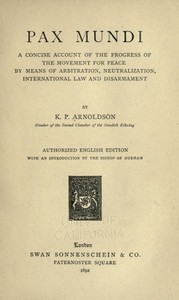
length
33,984 words
a few pages a day
~8 min
finished in
18 days
full read
2h 22m
At Folio's default of ten pages a day, you finish Pax mundi in about 18 days — roughly 8 minutes of reading each morning.
The opening
the first pages of Pax mundi, free
This little work, written by one who has long been known as a consistent and able advocate of the views herein maintained, has been translated by a lady who has already rendered great services to the cause, in the belief that it will be found useful by the increasing number of those who are interested in the movement for the substitution of Law for War in international affairs.
J.F.G.
INTRODUCTION TO THE ENGLISH EDITION.
It is natural that the advocates of international Peace should sometimes grow discouraged and impatient through what they are tempted to consider the slow progress of their cause. Sudden outbursts of popular feeling, selfish plans for national aggrandisement, unremoved causes of antipathy between neighbours, lead them to overlook the general tendency of circumstances and opinions which, when it is regarded on a large scale, is sufficient to justify their loftiest hopes. It is this general tendency of thought and fact, corresponding to the maturer growth of peoples, which brings to us the certain assurance that the Angelic Hymn which welcomed the Birth of Christ advances, slowly it may be as men count slowness, but at least unmistakably, towards fulfilment. There are pauses and interruptions in the movement; but, on the whole, no one who patiently regards the course of human history can doubt that we are drawing nearer from generation to generation to a practical sense of that brotherhood and that solidarity of men--both words are necessary--which find their foundation and their crown in the message of the Gospel.
Under this aspect the Essay of Mr. Arnoldson is of great value, as giving a calm and comprehensive view of the progress of the course of Peace during the last century, and of the influences which are likely to accelerate its progress in the near future.
Mr. Arnoldson, who, as a member of the Swedish Parliament, is a practical statesman, indulges in no illusions. The fulness with which he dwells on the political problems of Scandinavia shows that he is not inclined to forget practical questions under the attraction of splendid theories. He marks the chief dangers which threaten the peace of Europe, without the least sign of dissembling their gravity. And looking steadily upon them, he remains bold in hope; for confidence in a great cause does not come from disregarding or disparaging the difficulties by which it is beset, but from the reasonable conviction that there are forces at work which are adequate to overcome them.
We believe that it is so in the case of a policy of Peace; and the facts to which Mr. Arnoldson directs attention amply justify the belief. It is of great significance that since 1794 there have been "at least sixty-seven instances in which disputes of a menacing character have been averted by arbitration"; and perhaps the unquestioning acceptance by England of the Genevan award will hereafter be reckoned as one of her noblest services to the world. It is no less important that since the principle of arbitration was solemnly recognised by the Congress of Paris in 1856, arbitral clauses have been introduced into many treaties, while the question of establishing a universal system of international arbitration has been entertained and discussed sympathetically by many parliaments.
At the same time Mr. Arnoldson justly insists on the steady increase of the power of neutrals. Without accepting the possibility of "a Neutral League," he points out how a necessary regard to the interests of neutrals restrains the powers which are meditating war. And I cannot but believe that he is right when he suggests that the problems of the neutralization of Scandinavia, of Alsace and Lorraine, of the Balkan States, of the Bosphorus and Dardanelles, demand the attention of all who seek to hasten "the coming peace."
It would be easy to overrate the direct value of these facts; but their value as signs of the direction in which public opinion is rapidly moving can hardly be overrated. They are symptoms of a growing recognition of the obligations of man to man, and of people to people, of our common human interests and of our universal interdependence.
I should not lay great stress on the deterrent power of the prospect of the ruinous losses and desolations likely to follow from future wars. A great principle might well demand from a nation great sacrifices; and the very strength of a policy of Peace lies in the postponement of material interests to human duties. But none the less the wide expansion of commercial and social intercourse, joint enterprises, even rivalries not always ungenerous, exercise a salutary influence upon the feeling of nation for nation, and make what were once regarded as natural animosities no longer possible.
Keep going from exactly here — Folio remembers your place and serves the next portion tomorrow.
continue reading Pax mundiAbout this free edition
Pax mundi by K. P. Arnoldson (1844-1916) is free to read in full. Folio serves it in daily portions you can actually finish, tracks your streak and reading position across devices, and reads every page aloud with a built-in narrator. The text comes from Project Gutenberg.
More like Pax mundi
Meditations
Folio
Meditations
Marcus Aurelius
The Enchiridion
Epictetus
Thus Spake Zarathustra
Friedrich Nietzsche
Beyond Good and Evil
Folio
Beyond Good and Evil
Friedrich Nietzsche
The Genealogy of Morals
Folio
The Genealogy of Morals
Friedrich Nietzsche
The Republic
Folio
The Republic
Plato
Apology
Folio
Apology
Plato
Crito
Folio
Crito
Plato