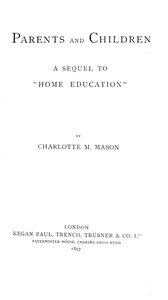
length
121,896 words
a few pages a day
~8 min
finished in
65 days
full read
8h 28m
At Folio's default of ten pages a day, you finish Parents and children in about 65 days — roughly 8 minutes of reading each morning.
The opening
the first pages of Parents and children, free
It is probable that no other educational thinker has succeeded in affecting parents so profoundly as did Rousseau. Emile is little read now, but how many current theories of the regimen proper for children have there their unsuspected source? Everybody knows--and his contemporaries knew it better than we--that Jean Jacques Rousseau had not enough sterling character to warrant him to pose as an authority on any subject, least of all on that of education. He sets himself down a poor thing, and we see no cause to reject the evidence of his Confessions. We are not carried away by the charm of his style; his “forcible feebleness” does not dazzle us. No man can say beyond that which he is, and there is a want of grit in his philosophic theories that removes most of them from the category of available thought.
But Rousseau had the insight to perceive one of those patent truths which, somehow, it takes a genius to discover; and, because truth is indeed prized above rubies, the perception of that truth gave him rank as a great teacher. “Is Jean Jacques also among the prophets?” people asked, and ask still; and that he had thousands of fervent disciples amongst the educated parents of Europe, together with the fact that his teaching has filtered into many a secluded home of our own day, is answer enough. Indeed, no other educationalist has had a tithe of the influence exercised by Rousseau. Under the spell of his teaching, people in the fashionable world, like that Russian Princess Galitzin, forsook society, and went off with their children to some quiet corner where they could devote every hour of the day, and every power they had, to the fulfilment of the duties which devolve upon parents. Courtly mothers retired from the world, sometimes even left their husbands, to work hard at the classics, mathematics, sciences, that they might with their own lips instruct their children. “What else am I for?” they asked; and the feeling spread that the bringing up of the children was the one work of primary importance for men and women.
Whatever extravagance he had seen fit to advance, Rousseau would still have found a following, because he had chanced to touch a spring that opened many hearts. He was one of the few educationalists who made his appeal to the parental instincts. He did not say, “We have no hope of the parents, let us work for the children!” Such are the faint-hearted and pessimistic things we say to-day. What he said was, in effect, “Fathers and mothers, this is your work, and you only can do it. It rests with you, parents of young children, to be the saviours of society unto a thousand generations. Nothing else matters. The avocations about which people weary themselves are as foolish child’s play compared with this one serious business of bringing up our children in advance of ourselves.”
People listened, as we have seen; the response to his teaching was such a letting out of the waters of parental enthusiasm as has never been known before nor since. And Rousseau, weak and little worthy, was a preacher of righteousness in this, that he turned the hearts of the fathers to the children, and so far made ready a people prepared for the Lord. But alas! having secured the foundation, he had little better than wood, hay, and stubble to offer to the builders.
Keep going from exactly here — Folio remembers your place and serves the next portion tomorrow.
continue reading Parents and childrenAbout this free edition
Parents and children by Charlotte M. Mason (1842-1923) is free to read in full. Folio serves it in daily portions you can actually finish, tracks your streak and reading position across devices, and reads every page aloud with a built-in narrator. The text comes from Project Gutenberg.
More like Parents and children
Meditations
Folio
Meditations
Marcus Aurelius
The Enchiridion
Epictetus
Thus Spake Zarathustra
Friedrich Nietzsche
Beyond Good and Evil
Folio
Beyond Good and Evil
Friedrich Nietzsche
The Genealogy of Morals
Folio
The Genealogy of Morals
Friedrich Nietzsche
The Republic
Folio
The Republic
Plato
Apology
Folio
Apology
Plato
Crito
Folio
Crito
Plato