length
80,134 words
a few pages a day
~8 min
finished in
43 days
full read
5h 34m
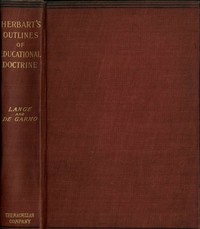
At Folio's default of ten pages a day, you finish Outlines of Educational Doctrine in about 43 days — roughly 8 minutes of reading each morning.
The opening
the first pages of Outlines of Educational Doctrine, free
The reasons for translating and annotating Herbart’s “Outlines” are, first, to present to the English-speaking public Herbart’s latest, and also his most complete, work on education; and, second, to note to some extent at least the advances made in educational thought since Herbart laid down his pen.
Herbart’s educational writings are distinguished by two marked characteristics: 1, their helpfulness in actual teaching; and 2, their systematic completeness. The thoughtful reader can see the bearing of each part upon all the others; the purposes of education are so completely correlated with the means, that, whether the topic under discussion be apperception or interest or methods of teaching or school government or moral training or the presentation of a particular study, the reader is never at a loss to see the relation of this part to the whole.
The eminent practicability of Herbart’s thought depends upon his psychological point of view, which is always that of concrete experience. The moment one tries to apply rational psychology to actual teaching, one begins to rise into the clouds, to become vague or, at least, general. The reason for this is that rational psychology deals with unchangeable presuppositions of mind. We may conform our work to these standards, but we cannot modify them, any more than we can a law of nature. But when we have to deal with an apperceiving content, we feel at home, for over this we have some control. We can build up moral maxims, we can establish permanent interests, we can reveal the unfolding of whole developments of thought and effort, we can fix the time order of studies and parts of studies; in short, we can apply our pedagogical insight with some degree of success to actual school problems. Though empirical psychology has in the last fifty years had as rapid a development as any other department of science, it has never departed essentially from the direction fixed by Herbart. New methods have indeed been applied, but the leading motive has remained empirical; it has had small tendency to drift toward rational psychology. This fact makes Herbart’s educational thought, so far as psychological bearing is concerned, seem as fresh and modern as when it was first recorded.
In one important respect, however, Herbart’s system needs modernizing. It is in relating education to conditions of society as it now exists. German society has never been that of English-speaking countries; much less does German society of the early part of the nineteenth century correspond to Anglo-Saxon society at the beginning of the twentieth. Indeed, even had there been correspondence before, there would be divergence now. It is one of the main purposes of the annotation, therefore, to point out the social implications of various parts of the “Outlines.”
The annotation has made no attempt to improve Herbart’s prophetic vision concerning many important matters, or to elucidate self-evident propositions, or to supplement observations already complete, true, and apt.
Especial attention is called to the exactness and illuminating character of Herbart’s diagnosis of mental weaknesses and disorders in children, together with his suggestions as to proper treatment. Students of child-study, moreover, will find in this work not only encouragement in their work, but also assistance in determining what is worth studying in the child. The reader is constantly reminded of the fact that, when written by a master, no book is newer than an old one.
Keep going from exactly here — Folio remembers your place and serves the next portion tomorrow.
continue reading Outlines of Educational DoctrineAbout this free edition
Outlines of Educational Doctrine by Johann Friedrich Herbart (1776-1841) is free to read in full. Folio serves it in daily portions you can actually finish, tracks your streak and reading position across devices, and reads every page aloud with a built-in narrator. The text comes from Project Gutenberg.
More like Outlines of Educational Doctrine
Meditations
Folio
Meditations
Marcus Aurelius
The Enchiridion
Epictetus
Thus Spake Zarathustra
Friedrich Nietzsche
Beyond Good and Evil
Folio
Beyond Good and Evil
Friedrich Nietzsche
The Genealogy of Morals
Folio
The Genealogy of Morals
Friedrich Nietzsche
The Republic
Folio
The Republic
Plato
Apology
Folio
Apology
Plato
Crito
Folio
Crito
Plato