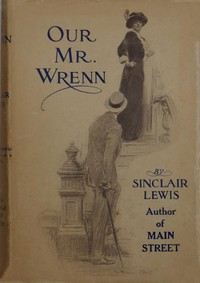
Our Mr. Wrenn: The Romantic Adventures of a Gentle Man
free to read
length
76,098 words
a few pages a day
~8 min
finished in
41 days
full read
5h 17m
At Folio's default of ten pages a day, you finish Our Mr. Wrenn: The Romantic Adventures of a Gentle Man in about 41 days — roughly 8 minutes of reading each morning.
The opening
the first pages of Our Mr. Wrenn: The Romantic Adventures of a Gentle Man, free
The ticket-taker of the Nickelorion Moving-Picture Show is a public personage, who stands out on Fourteenth Street, New York, wearing a gorgeous light-blue coat of numerous brass buttons. He nods to all the patrons, and his nod is the most cordial in town. Mr. Wrenn used to trot down to Fourteenth Street, passing ever so many other shows, just to get that cordial nod, because he had a lonely furnished room for evenings, and for daytime a tedious job that always made his head stuffy.
He stands out in the correspondence of the Souvenir and Art Novelty Company as “Our Mr. Wrenn,” who would be writing you directly and explaining everything most satisfactorily. At thirty-four Mr. Wrenn was the sales-entry clerk of the Souvenir Company. He was always bending over bills and columns of figures at a desk behind the stock-room. He was a meek little bachlor—a person of inconspicuous blue ready-made suits, and a small unsuccessful mustache.
To-day—historians have established the date as April 9, 1910—there had been some confusing mixed orders from the Wisconsin retailers, and Mr. Wrenn had been “called down” by the office manager, Mr. Mortimer R. Guilfogle. He needed the friendly nod of the Nickelorion ticket-taker. He found Fourteenth Street, after office hours, swept by a dusty wind that whisked the skirts of countless plump Jewish girls, whose V-necked blouses showed soft throats of a warm brown. Under the elevated station he secretly made believe that he was in Paris, for here beautiful Italian boys swayed with trays of violets; a tramp displayed crimson mechanical rabbits, which squeaked, on silvery leading-strings; and a newsstand was heaped with the orange and green and gold of magazine covers.
“Gee!” inarticulated Mr. Wrenn. “Lots of colors. Hope I see foreign stuff like that in the moving pictures.”
He came primly up to the Nickelorion, feeling in his vest pockets for a nickel and peering around the booth at the friendly ticket-taker. But the latter was thinking about buying Johnny’s pants. Should he get them at the Fourteenth Street Store, or Siegel-Cooper’s, or over at Aronson’s, near home? So ruminating, he twiddled his wheel mechanically, and Mr. Wrenn’s pasteboard slip was indifferently received in the plate-glass gullet of the grinder without the taker’s even seeing the clerk’s bow and smile.
Mr. Wrenn trembled into the door of the Nickelorion. He wanted to turn back and rebuke this fellow, but was restrained by shyness. He had liked the man’s “Fine evenin’, sir “—rain or shine—but he wouldn’t stand for being cut. Wasn’t he making nineteen dollars a week, as against the ticket-taker’s ten or twelve? He shook his head with the defiance of a cornered mouse, fussed with his mustache, and regarded the moving pictures gloomily.
They helped him. After a Selig domestic drama came a stirring Vitagraph Western scene, “The Goat of the Rancho,” which depicted with much humor and tumult the revolt of a ranch cook, a Chinaman. Mr. Wrenn was really seeing, not cow-punchers and sage-brush, but himself, defying the office manager’s surliness and revolting against the ticket-man’s rudeness. Now he was ready for the nearly overpowering delight of travel-pictures. He bounced slightly as a Gaumont film presented Java.
He was a connoisseur of travel-pictures, for all his life he had been planning a great journey. Though he had done Staten Island and patronized an excursion to Bound Brook, neither of these was his grand tour. It was yet to be taken. In Mr. Wrenn, apparently fastened to New York like a domestic-minded barnacle, lay the possibilities of heroic roaming. He knew it. He, too, like the man who had taken the Gaumont pictures, would saunter among dusky Javan natives in “markets with tiles on the roofs and temples and—and—uh, well—places!” The scent of Oriental spices was in his broadened nostrils as he scampered out of the Nickelorion, without a look at the ticket-taker, and headed for “home”—for his third-floor-front on West Sixteenth Street. He wanted to prowl through his collection of steamship brochures for a description of Java. But, of course, when one’s landlady has both the sciatica and a case of Patient Suffering one stops in the basement dining-room to inquire how she is.
Keep going from exactly here — Folio remembers your place and serves the next portion tomorrow.
continue reading Our Mr. Wrenn: The Romantic Adventures of a Gentle ManAbout this free edition
Our Mr. Wrenn: The Romantic Adventures of a Gentle Man by Sinclair Lewis (1885-1951) is free to read in full. Folio serves it in daily portions you can actually finish, tracks your streak and reading position across devices, and reads every page aloud with a built-in narrator. The text comes from Project Gutenberg.
More like Our Mr. Wrenn: The Romantic Adventures of a Gentle Man
Free Air
Folio
Free Air
Sinclair Lewis
Hike and the aeroplane
Sinclair Lewis
Main Street
Folio
Main Street
Sinclair Lewis

Babbitt
Sinclair Lewis
The Innocents: A Story for Lovers
Folio
The Innocents: A Story for Lovers
Sinclair Lewis
Pride and Prejudice
Jane Austen
Sense and Sensibility
Jane Austen
Emma
Folio
Emma
Jane Austen