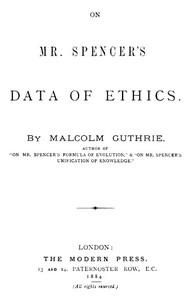
On Mr. Spencer's Data of Ethics
free to read
length
35,906 words
a few pages a day
~8 min
finished in
19 days
full read
2h 30m
At Folio's default of ten pages a day, you finish On Mr. Spencer's Data of Ethics in about 19 days — roughly 8 minutes of reading each morning.
The opening
the first pages of On Mr. Spencer's Data of Ethics, free
This volume completes the critical examination of Mr. Spencer's system of Philosophy already pursued through two previous volumes entitled respectively "On Mr. Spencer's Formula of Evolution," and "On Mr. Spencer's Unification of Knowledge." The entire task has been undertaken by a student for the use of students. It cannot be of much use to the general reader, as it presumes and indeed requires a very intimate knowledge of Mr. Spencer's works. For those who do not wish to enter into detailed examination perhaps Chapter I. of the "Unification of Knowledge" will afford a good epitome of the line of criticism; and this may be followed, if desired, by a perusal of the "Formula of Evolution." It is believed that the most serious piece of criticism against Mr. Spencer's system will be found in the examination of his re-constructive Biology in Chapter V. of the "Unification," and in the examination of the origin of organic molecules commencing at page 30 of the "Formula of Evolution." Evidently of the highest importance in a system of philosophy conceived in the manner in which Mr. Spencer presents it, this point of transition between the inorganic and the organic with its dependent histories is of the very deepest fundamental interest, and upon the question whether it is well or badly treated depends the practical value of his philosophy as applied to human concerns.
In our opinion, whatever of worth there is in Mr. Spencer's works (and there is very much), derives its value from a posteriori grounds and not from its a priori reliance upon first principles, nor from its place in a deductive system of cosmic philosophy. It has not fallen to our lot, nor has it been our object, to appraise the separate or incidental value of Mr. Spencer's works. Our view has been limited to the single object of examining them in the mode in which he presents them, as forming a connected system of philosophy. We have done so because he sets forth his works to us in this light, and evidently if they can be so accepted, it would be a gift to humanity of the highest value, for it would lend cogency to every past and confer a guidance to all future ages, forming a crowning glory to the intellectual achievements of the human race.
It is therefore to this point that we address our examination, and in no unfriendly spirit; for the object Mr. Spencer had in view was one which appealed to every sentiment and every intellectual aspiration within us. But we feel bound to say how sadly we have been disappointed. We have found the object of our admiration to be like Nebuchadnezzar's dream god, a thing apparently perfect and complete in configuration but like the image compounded of iron and clay and precious stones inevitably falling to pieces under the strain of sustained criticisms.
Mr. Spencer's philosophic conception was indeed imposing, and before its magnificent proportions many have bowed down in sincere respect. But his cosmical scheme when carefully examined proved to be constructed of terms which had no fixed and definite meaning, which were in fact merely symbols of symbolic conceptions, conceptions themselves symbolic because they were not understood--and the moment we began to put them to use as having definite values they landed us forthwith in alternative contradictions! Then to effect cosmical evolution, which is a process of imperceptible objective change, what was necessary, but to adopt a system of imperceptible word changes, so that the imperceptible word changes accompanying the imperceptible objective changes should lead us in the end to the completed results, and the process of evolution should thus be made comprehensible! In this manner over the spaces of an enormous work have we been skilfully led by a master of language till we find ourselves in imagination following out mentally the actual processes of the universe. But after all it has only been a process, in our own minds, of the skilful substitution of words!
Keep going from exactly here — Folio remembers your place and serves the next portion tomorrow.
continue reading On Mr. Spencer's Data of EthicsAbout this free edition
On Mr. Spencer's Data of Ethics by Malcolm Guthrie is free to read in full. Folio serves it in daily portions you can actually finish, tracks your streak and reading position across devices, and reads every page aloud with a built-in narrator. The text comes from Project Gutenberg.
More like On Mr. Spencer's Data of Ethics
Meditations
Folio
Meditations
Marcus Aurelius
The Enchiridion
Epictetus
Thus Spake Zarathustra
Friedrich Nietzsche
Beyond Good and Evil
Folio
Beyond Good and Evil
Friedrich Nietzsche
The Genealogy of Morals
Folio
The Genealogy of Morals
Friedrich Nietzsche
The Republic
Folio
The Republic
Plato
Apology
Folio
Apology
Plato
Crito
Folio
Crito
Plato